How Booking a Slow Boat Journey Along the Mekong from Huay Xai to Luang Prabang Replaces Both a Flight and a Hotel Night While Delivering an Unrepeatable Laos Experience
Some journeys resist the logic of efficiency entirely, and that resistance is precisely what makes them worth taking. The slow boat along the Mekong River — a two-day wooden vessel journey connecting the border town of Huay Xai with the UNESCO-listed city of Luang Prabang — belongs to a category of travel that collapses the distinction between transit and destination. It is transportation that becomes the experience itself, replacing both a short domestic flight and an overnight hotel stay with something far more difficult to price: sustained immersion in one of Southeast Asia's most quietly spectacular landscapes.
The Practical Logic Behind a Slow Crossing
The economics of the Mekong slow boat hold up even before the scenery enters the equation. The journey takes roughly two days, with an overnight stop in the riverside village of Pakbeng — a settlement that exists almost entirely because travelers need somewhere to sleep between the two legs of the crossing. A ticket on one of the long, low wooden vessels that make the route covers the distance from Huay Xai to Luang Prabang at a cost that, when compared to a domestic Lao Airlines flight plus a night's accommodation in a mid-range guesthouse along any other route, often comes in equal or lower. The boat fare and a simple guesthouse room in Pakbeng together frequently undercut the combined flight-and-hotel alternative, and that calculation doesn't account for the bus or tuk-tuk transfers that airport travel in this region inevitably demands.
What the River Reveals Over Two Days
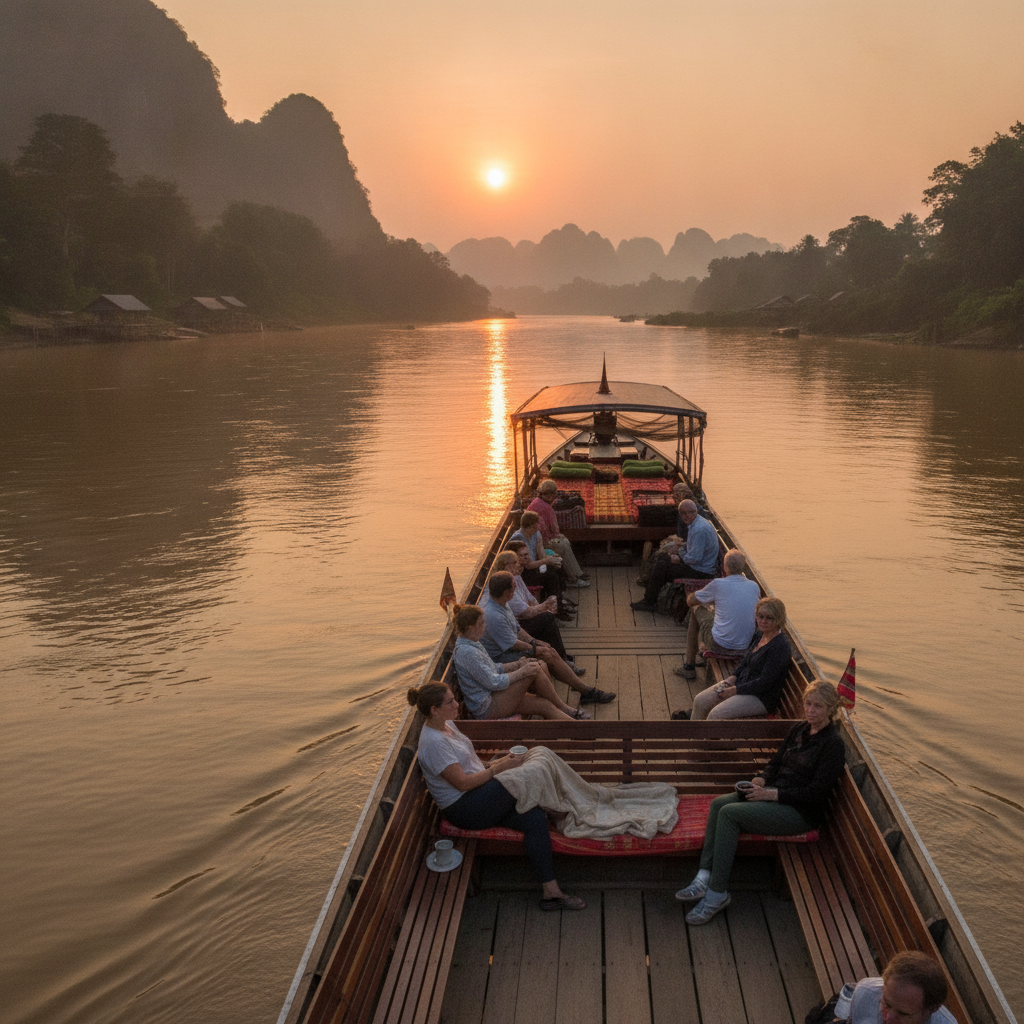
The Mekong through northern Laos runs between limestone karst formations and dense forest that descends almost directly to the waterline. There are no roads visible from the river for long stretches, no power lines interrupting the ridgeline, and no audible evidence of the twenty-first century beyond the boat's engine. Fishermen in narrow pirogues — the slender dugout vessels used throughout the region — work the shallower channels along the banks. Occasionally, a small settlement appears: a cluster of wooden houses on stilts, a group of children watching the boat pass, a woman washing fabric at the water's edge. These moments are unhurried and unrepeatable in a way that no highlight reel from a travel platform can adequately convey, because they unfold in real time over hours rather than in the compressed format of a highlight reel.
Pakbeng and the Art of Stopping
The overnight stop in Pakbeng deserves more attention than it typically receives in standard travel advice. The village sits on a steep hillside above the river, its guesthouses and noodle shops oriented almost entirely toward slow boat passengers. It would be easy to dismiss Pakbeng as a functional pause — a place merely to sleep before continuing — but the evening hours there carry their own particular quality. The population of the boat empties onto the same narrow main street, and the shared context of the day's journey creates an unusual social ease among strangers. Guesthouses like Mekong Riverside Lodge offer basic but clean accommodation that costs a fraction of what comparable riverside rooms in Luang Prabang command. Eating khao piak sen — a thick, rice-flour noodle soup that functions as the regional comfort food of northern Laos — at one of the simple wooden restaurants overlooking the water at dusk is one of those quietly perfect travel meals that costs almost nothing and lingers in memory for years.
Reading the Journey as a Budget Strategy
For travelers whose itinerary involves crossing from Thailand into Laos — entering at the Chiang Khong-Huay Xai border crossing — the slow boat removes an entire accommodation decision from the planning process. The Pakbeng night replaces what would otherwise be either a rushed transit in Chiang Rai or an early morning flight connection that requires building buffer time and buffer cost into the schedule. What the slow boat offers, in straightforward budget terms, is the consolidation of two separate line items — transportation and lodging — into a single, manageable booking. Tickets are arranged through guesthouses and travel agents in Chiang Khong or Huay Xai, and the process is informal enough that reserving a day or two in advance is typically sufficient outside of peak season months.
Arriving in Luang Prabang by Water
The approach to Luang Prabang by river is an experience that arriving by air simply cannot replicate. The boat slows as the Mekong bends toward the city, and the golden stupa of Wat Xieng Thong appears above the treeline before the dock comes into view. Luang Prabang has been described as one of the best-preserved traditional towns in Southeast Asia, and entering it from the water — after two days of watching the river change character through gorges and open valleys — creates a continuity of experience that feels genuinely earned. The city's famous tak bat ceremony, the pre-dawn procession in which saffron-robed monks collect alms from residents along Sisavangvong Road, feels more resonant when the traveler arrives having moved at the river's pace rather than at the pace of a one-hour flight.
What Slow Travel Restores
There is a particular quality of attention that sustained, unhurried movement produces — a quality that has become increasingly scarce in travel organized around maximum destination coverage in minimum time. The slow boat enforces a kind of presence that most modern itineraries actively work against. Passengers read, watch the banks, sleep, eat the simple meals sold from a small galley, and talk to the strangers seated nearby on wooden benches. The river offers enough visual variation to remain engaging across the full two days without requiring anything of the traveler except willingness to be moved through a landscape slowly. That willingness, it turns out, is both the cost and the reward of the crossing.
The slow boat from Huay Xai to Luang Prabang works as a travel strategy precisely because it refuses to separate the practical from the experiential. What begins as a calculation — one ticket replacing a flight and a hotel night — becomes something else entirely by the time the boat docks below the temples of Luang Prabang. The river that opened as a budget decision closes as a memory, and the two days spent moving through northern Laos at the speed of water turn out to be among the most complete and uninterrupted stretches of genuine rest that travel in this part of the world can offer.