
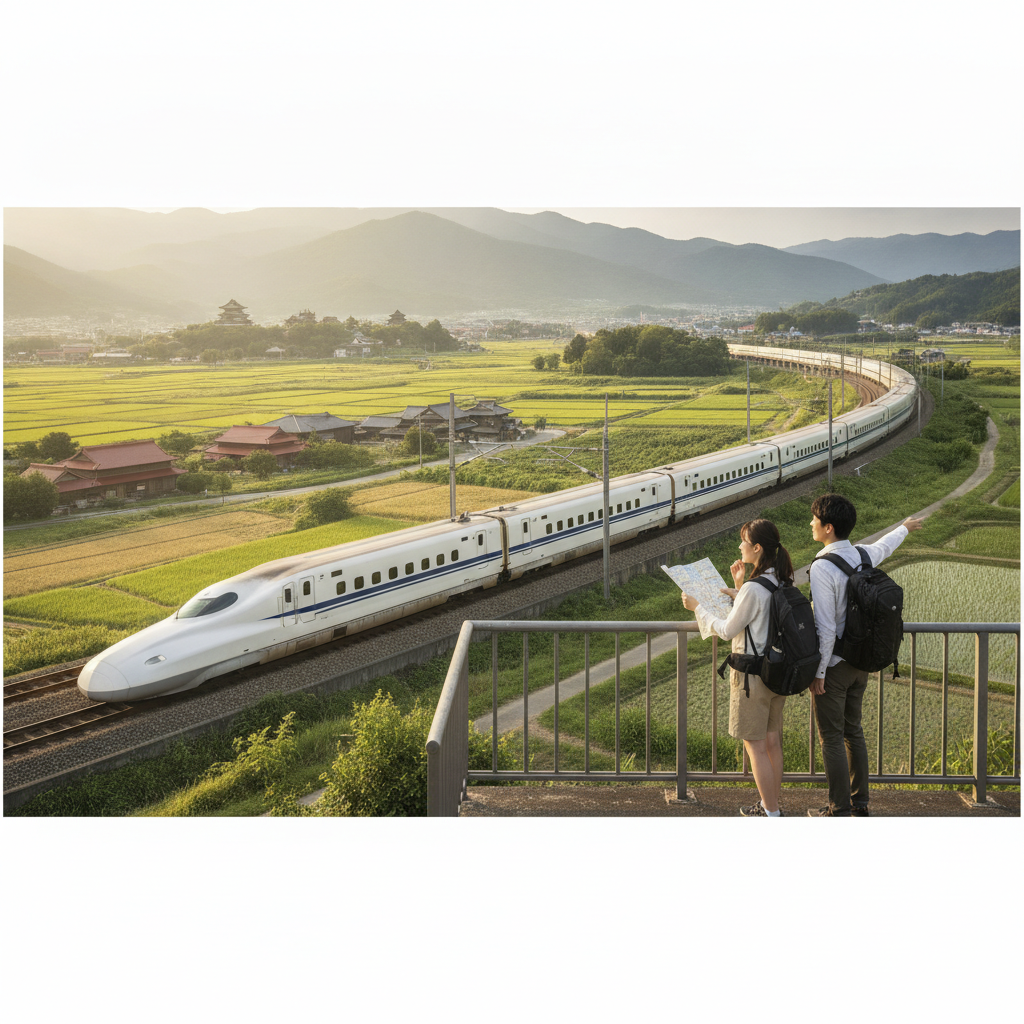
How Structuring a First-Time Japan Trip Around a Single Shinkansen Corridor Instead of a Multi-City Loop Cuts Transport Costs and Deepens Regional Understanding
Most first-time visitors to Japan arrive with an ambitious map: Tokyo one day, Kyoto the next, then Hiroshima, Osaka, maybe Nara squeezed somewhere in between. That instinct is understandable — Japan feels enormous on paper, and the shinkansen makes everything seem reachable. But the classic multi-city loop often costs more than expected and leaves travelers with a surface-level experience of many places rather than a real feel for any of them. Choosing a single corridor instead changes both the budget math and the quality of what you actually absorb.
What Does a Single Corridor Actually Mean?
A shinkansen corridor is a linear stretch of high-speed rail connecting a cluster of cities and towns along one spine. The Tokaido-Sanyo Shinkansen, which runs from Tokyo through Nagoya, Kyoto, Osaka, Kobe, and down to Hiroshima, is the most famous. Instead of bouncing between multiple corridors or adding Tohoku or Kyushu segments, you pick one line and stay on it. You choose a home base — Kyoto and Osaka are the most practical — and make day trips in both directions rather than checking out of one hotel to check into another every two nights.
How Does Staying on One Line Reduce Transport Costs?
The JR Pass is often cited as the automatic solution for getting around Japan, but it only makes financial sense if you're covering long distances repeatedly. When you anchor to one corridor, you can often skip the pass entirely and buy individual reserved-seat tickets for a handful of longer trips while using IC cards like Suica for everything local. A single Tokyo-to-Kyoto shinkansen ticket is a defined cost you can plan around. Compare that to the mental accounting of trying to justify a seven-day or fourteen-day JR Pass across a sprawling loop — many travelers who crunch the numbers post-trip realize they didn't come close to breaking even.
Why Does a Base City Outperform Nightly Hotel Hopping?
Checking out every two days isn't just logistically tiring — it's quietly expensive. Resort fees, late checkout charges, and the premium pricing of hotels near major shinkansen stations add up faster than most itineraries account for. When you book a single apartment or hotel in a neighborhood like Fushimi in Kyoto or Namba in Osaka for seven or eight nights, you benefit from weekly rates, you learn how the local grocery stores and transit lines work, and you stop spending mental energy on logistics. That cognitive space gets redirected toward actually experiencing where you are.
What Regional Understanding Do You Gain That Loop Travel Misses?
The Tokaido corridor alone contains enough distinct regional identity to fill two weeks comfortably. Nagoya has its own food culture built around miso katsu and hitsumabushi eel rice — neither of which you find in the same form anywhere else on the line. The stretch between Kyoto and Osaka holds Nishiki Market, Arashiyama, Fushimi Inari, and the Dotonbori canal district within a combined metro area that rewards slow exploration. Himeji sits an easy forty minutes west of Osaka by shinkansen and offers one of Japan's best-preserved feudal castles without the crowds that mob more famous sites. When you're already based along the corridor, these destinations become afternoon choices rather than logistical commitments.
How Do You Structure Day Trips Without Feeling Rushed?
The advantage of the shinkansen's frequency — trains on the Tokaido line run every few minutes during peak hours — is that you don't need to plan departures days in advance. A day trip to Hiroshima from Osaka takes about ninety minutes each way on the Nozomi service. That leaves six to seven hours on the ground, which is genuinely enough time for Miyajima Island's floating torii gate and the Peace Memorial Museum without feeling compressed. The same logic applies to a morning in Nara, a day in Himeji, or a slower afternoon in Kobe's Kitano-cho district. You return each evening to a familiar neighborhood rather than an unfamiliar hotel room.
When Does the Multi-City Loop Actually Make Sense?
The loop strategy isn't inherently wrong — it's just better suited to repeat visitors or people with specific goals in multiple regions. If you have a compelling reason to reach Sapporo, Fukuoka, or the Kyushu hot spring towns of Beppu and Yufuin, then a broader pass might justify itself. But for a first trip where you're trying to get a genuine feel for Japanese daily life, food, architecture, and neighborhood culture, spreading yourself across the full length of the country works against you. The goal of a first visit is to leave with a real sense of a place, not a checklist of stations visited.
How Should You Choose Between Kyoto and Osaka as a Base?
Both cities anchor the corridor well, but they serve different travel styles. Kyoto rewards people who want temples, bamboo groves, traditional ryokan culture, and the quieter residential feel of neighborhoods like Gion and Higashiyama. Osaka is faster, louder, and more food-obsessed — it's the better base if you want street food, night markets, and a more urban energy as your daily backdrop. Some travelers split the difference by booking a few nights in each, which works fine as long as both stays are long enough to settle in. Splitting four nights between two cities is still better than one night in seven cities.
What Practical Booking Steps Lock In the Savings?
Start by confirming your base city before buying any transport. Once that's decided, price out individual shinkansen tickets for the two or three longer trips you're likely to take — Tokyo to Kyoto is the most common, and booking through the JR website or Klook at least a few weeks out often secures reserved seats without the need for a full pass. For everything within the corridor — local trains, subway lines, buses — load a Suica card at any major station and tap in and out everywhere. This combination typically costs less than a standard JR Pass for itineraries that stay on one corridor, and it simplifies every transaction.
Structuring a Japan trip around a single shinkansen corridor isn't a compromise — it's a deliberate choice that produces a better trip and a lower transport bill at the same time. You leave with a genuine understanding of a region rather than a blurred impression of several. The shinkansen will still be fast, the food will still be exceptional, and the temples will still be as extraordinary as you've heard. You'll just have the time and presence of mind to actually absorb them.