
How Reading Portable Generator Wattage Surge Ratings Against Your Actual Household Appliance Load Prevents Buying Undersized Equipment That Fails When You Need It Most
Portable generators fail their owners most often not because of mechanical defects, but because buyers chose models based on running watts alone — ignoring the surge demands that appliances create the moment they power on. Understanding the difference between these two wattage figures, and matching them accurately against a real household load calculation, is the single most consequential decision anyone makes when shopping for backup power equipment.
The Difference Between Running and Surge Watts
Every portable generator carries two wattage ratings: running watts, which describe sustained output during normal operation, and surge watts — sometimes called starting watts — which represent the brief peak the unit can deliver when a motor-driven appliance kicks on. Refrigerators, sump pumps, air conditioners, and well pumps all require two to three times their running wattage for the first few seconds of startup. A generator sized only to cover running loads will trip its breaker or stall its engine the instant a compressor cycles on, rendering it useless at exactly the moment protection is needed most.
Building an Accurate Household Appliance Load List
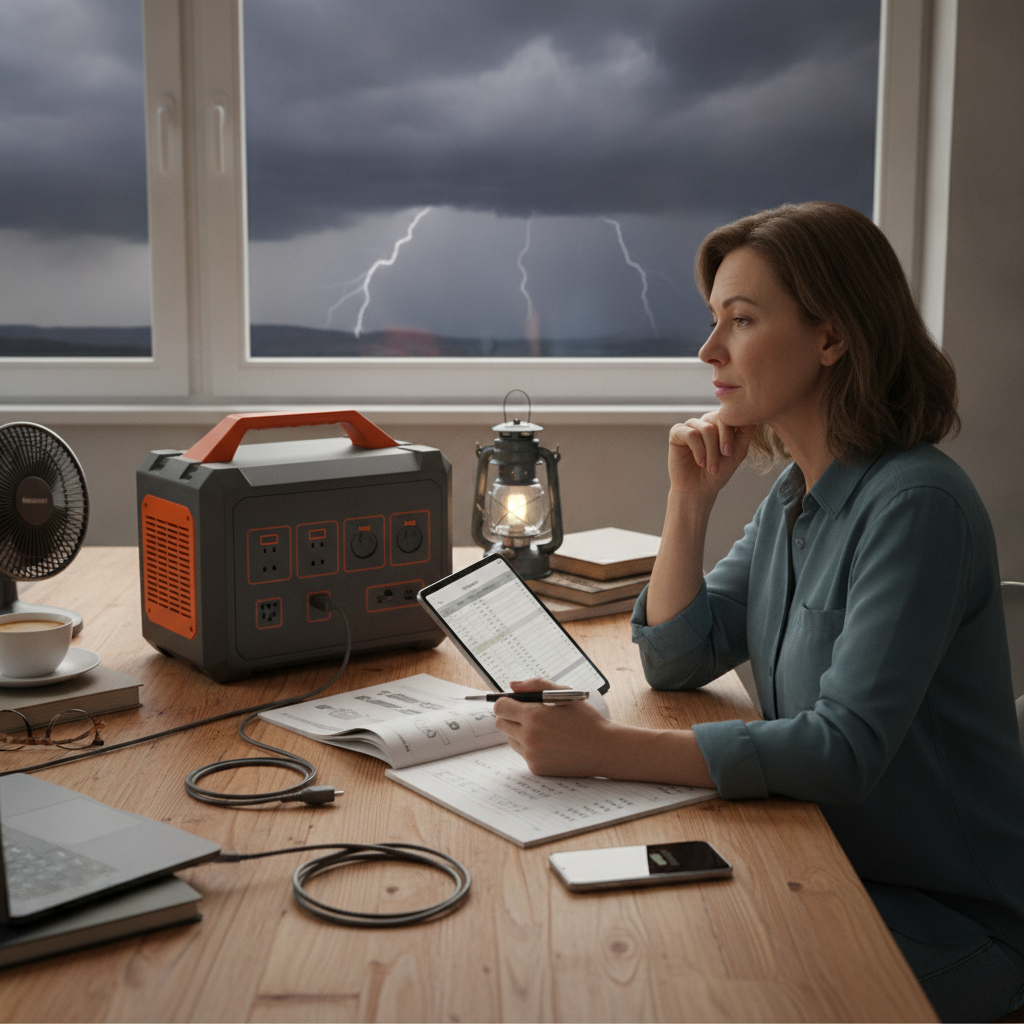
A reliable load calculation begins with listing every appliance a household intends to run during an outage, along with both its running and starting wattage figures. These numbers appear on the appliance's data plate, usually located on the rear or interior panel, and can also be found in the owner's manual or the manufacturer's website. Brands like Honda, Generac, and Champion publish appliance wattage reference guides that make this step significantly easier. The goal isn't to power everything simultaneously — it's to identify which combination of appliances will run concurrently, and what surge demand that combination creates.
How Surge Stacking Creates Unexpected Demand Spikes
The challenge most buyers underestimate is surge stacking — the compounded startup demand that occurs when multiple motor-driven appliances cycle on within seconds of each other. A refrigerator starting while a sump pump simultaneously kicks on can briefly demand six thousand watts or more from a unit rated at only five thousand running watts. Even modest household configurations can produce surge requirements that overwhelm mid-range generators. Calculating the worst-case simultaneous surge scenario — not the average load — is the correct baseline for sizing decisions, because generators don't fail during average conditions; they fail at peak demand.
Matching Generator Ratings to Your Calculated Load
Once the load list is complete and the peak surge demand is identified, the generator's surge wattage rating — not its running wattage — must comfortably exceed that figure. A standard rule of thumb recommends leaving a twenty-percent buffer above the calculated peak surge to allow for degraded performance in hot weather, altitude, or aging equipment. Generac's GP6500 and Honda's EU7000iS are commonly referenced examples at the mid-to-upper residential tier, and both provide published surge capacity figures that make load matching straightforward. Buying to the edge of calculated need is one of the most common and costly errors in generator purchasing.
Why Transfer Switch Compatibility Affects Sizing Decisions
For households planning to connect a generator through a transfer switch — which isolates the home's circuits from the utility grid for safe indoor use — the sizing equation gains an additional variable. Transfer switches are rated by the maximum amperage they can handle, and some manual transfer switch panels prioritize only selected circuits, which effectively limits which appliances can draw power simultaneously. This architectural constraint can reduce peak surge demand in practice, sometimes allowing a slightly smaller generator to serve adequately. Understanding the transfer switch's circuit allocation before finalizing a generator purchase prevents both over-buying and dangerous improvised connections.
Choosing the Right Generator Before the Next Outage
When you're ready to make a purchasing decision, start by downloading a wattage worksheet — Generac, Briggs & Stratton, and most major home improvement retailers offer free printable versions. Walk through your home and note the running and starting wattage for every appliance you'd realistically need during a multi-day outage: refrigerator, freezer, sump pump, window AC unit, medical equipment, and lighting circuits. Add those surge figures for your most likely simultaneous startup scenario, apply a twenty-percent buffer, and use that number to filter generator options by their published surge watt rating. Buying a unit like the Westinghouse WGen9500 because it has impressive marketing language — rather than because its surge rating clears your calculated peak — is how undersized equipment ends up sitting useless in a garage after a storm.
Understanding wattage ratings isn't technical complexity for its own sake — it's the practical foundation of a buying decision that only matters when everything else has already gone wrong. Matching a generator's surge capacity to a real household load calculation, with an honest buffer built in, is what separates equipment that performs when the power goes out from equipment that simply looked sufficient on the store shelf.