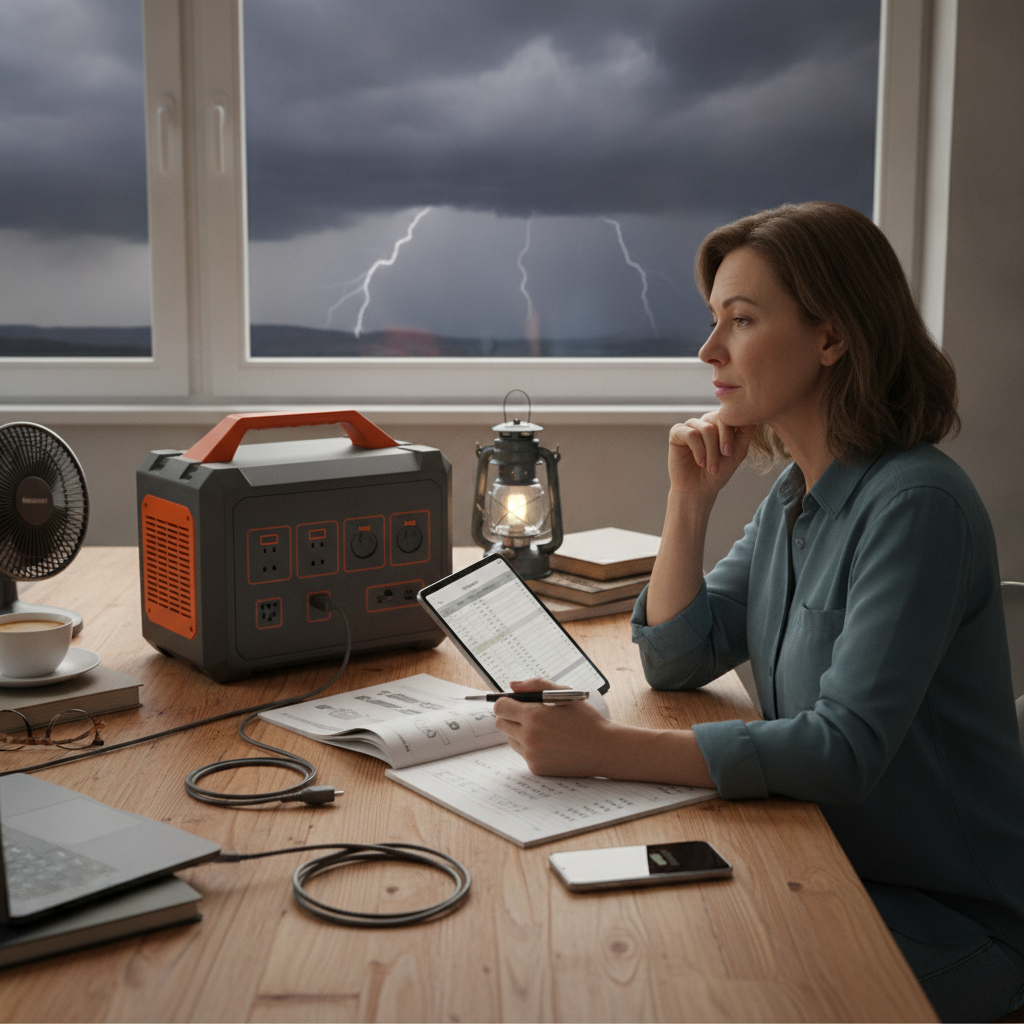
How Reading Portable Power Station Watt-Hour Capacity and Recharge Cycle Ratings Against Your Actual Emergency Use Scenarios Prevents Overpaying for Output Your Household Will Never Draw
Portable power stations are one of the most frequently overbought categories in emergency preparedness, with many households spending hundreds of dollars more than their actual needs require. The appeal is understandable — during a grid outage, the instinct is to buy the largest, most capable unit available. But capacity that never gets used doesn't protect a household; it simply inflates the purchase price. Learning to read two specific specifications — watt-hour capacity and recharge cycle ratings — against realistic emergency scenarios is the clearest path to buying the right unit at the right price.
Understanding What Watt-Hours Actually Measure
Watt-hours, abbreviated as Wh, describe how much total energy a portable power station can store and deliver before it needs recharging. A unit rated at 500Wh can theoretically deliver 500 watts for one hour, or 100 watts for five hours. The key word is theoretically, because real-world draw — factoring in inverter efficiency losses and device startup surges — typically reduces usable capacity by ten to fifteen percent. Brands like Jackery and Bluetti publish these figures prominently, but reading them in isolation, without comparing them against actual device wattages, tells a shopper very little about practical suitability.
Mapping Device Loads to Realistic Outage Scenarios
The most useful exercise before buying is building a simple device inventory for the most likely emergency scenario. For most households, that scenario is a one-to-three day weather-related outage, not a week-long grid failure. A CPAP machine typically draws between 30 and 60 watts. A box fan runs around 40 to 100 watts. LED lighting draws almost nothing by comparison. A phone charges at roughly 15 to 20 watts. Adding these figures across a realistic 24-hour window produces a usable target number — and that number is frequently well below the 1,000Wh to 2,000Wh tier that aggressive marketing pushes most buyers toward.
Why Recharge Cycle Ratings Matter as Much as Capacity
Capacity gets most of the attention, but recharge cycle ratings determine how long a unit remains useful over time. Most lithium iron phosphate, or LiFePO4, batteries — used in units like the EcoFlow Delta Pro — are rated for 3,500 or more cycles before degrading to 80 percent capacity. Standard lithium NMC batteries, which appear in lower-priced units, typically carry ratings of 500 to 800 cycles. For a household that tests or runs the unit once monthly during non-emergency periods, a 500-cycle battery lasts well over 40 years on paper. But if the same unit is used regularly for camping or backup power, cycle life becomes a meaningful differentiator between a durable investment and a depreciating purchase.
Where Overbying Consistently Happens in the Market
The most common mismatch occurs when buyers size up to the next capacity tier based on a single worst-case appliance — typically a refrigerator — without calculating whether keeping that appliance running is actually practical or necessary during a short outage. A full-size refrigerator draws between 100 and 400 watts and can safely hold temperature for four to six hours without power if the door stays closed. Attempting to run it continuously on a portable station consumes enormous capacity and often empties even a 1,500Wh unit within a day. The same budget spent on a smaller, well-specified unit paired with a compact 12-volt cooler from Goal Zero or similar produces a more functional emergency setup at a meaningfully lower price.
Reading Spec Sheets From Brands Like EcoFlow, Jackery, and Bluetti
Reputable brands publish detailed specification sheets that include not just capacity but surge wattage ratings, AC output waveform type, and input recharge wattage. Surge wattage matters because motor-driven devices — blenders, small compressors, power tools — draw two to three times their running wattage at startup. A unit with a 1,000W continuous output but only a 1,200W surge rating may trip its protection circuit the moment a sump pump kicks on. Cross-referencing the surge demands of every device in the emergency inventory against published surge specs takes less than ten minutes and prevents the kind of real-world failure that no amount of watt-hour capacity can compensate for.
Matching Your Purchase to What You Actually Need
Once you have your device inventory and your realistic outage scenario mapped out, the buying decision becomes significantly clearer. If your combined 24-hour load lands around 300Wh, a 500Wh unit with LiFePO4 chemistry covers your needs with a reasonable buffer without pushing you into the thousand-dollar tier. If you have a medical device with continuous overnight draw, calculate that specific load first — it may genuinely justify a larger unit, but the math should drive that conclusion rather than anxious upselling at the point of sale. Compare recharge input wattage too, since a unit that accepts 400W solar input recharges in roughly half the time of one limited to 200W, which matters during multi-day outages with sun availability. Use retailer comparison tools, check the spec sheets directly on manufacturer sites like EcoFlow's product pages, and resist bundle pricing that pairs oversized units with solar panels rated for capacities your household's load will never actually stress.
Matching watt-hour capacity and cycle ratings to genuine household emergency needs rather than theoretical maximums is the clearest way to avoid overpaying in this category. The right portable power station isn't the largest one available — it's the one sized precisely to what a household will realistically draw, built with battery chemistry durable enough to still perform when it's needed most.