How Reading Projector Lumen and Throw Ratio Specifications Against Your Actual Room Dimensions Prevents Overpaying for Home Theater Performance Your Space Cannot Support
Buying a home theater projector without measuring the room first is one of the most common — and most expensive — mistakes in consumer electronics shopping. Manufacturers list impressive brightness figures and flexible throw ratios on product pages, and retailers like Best Buy and Costco display projectors in showrooms engineered to make every model look spectacular. The problem is that those showrooms share almost nothing in common with a typical living room, basement, or dedicated media room. Understanding two core specifications — lumens and throw ratio — before making any purchase decision can mean the difference between a genuinely cinematic experience and an expensive disappointment.
What Do Projector Lumens Actually Measure?
Lumens measure a projector's total light output, expressed as ANSI lumens, which represents a standardized brightness rating across a defined projection area. A higher lumen count means a brighter image, but brightness needs context to be meaningful. In a room with complete light control — blackout curtains, no ambient sources, dark walls — a projector rated at 1,500 ANSI lumens can produce a stunning, high-contrast image. In a living room with afternoon sunlight filtering through standard blinds, that same projector struggles to compete with ambient light, producing a washed-out, low-contrast picture that no adjustment can fully rescue.
How Room Lighting Conditions Change Everything
Projector manufacturers typically list a single lumen figure, but the usable brightness depends heavily on the ambient light present during viewing. A dedicated home theater with true blackout conditions needs far fewer lumens than a family room used for both daytime and evening viewing. Epson's long-running PowerLite line, for example, segments its models explicitly around ambient light tolerance, offering separate product tiers for dark rooms versus mixed-use spaces. BenQ takes a similar approach with its W-series versus TK-series lineup. Buyers who purchase a dark-room-optimized projector for a light-permeable space are paying for a specification that their environment immediately negates — money spent on output that the room absorbs rather than reflects.
What Throw Ratio Means and Why It Governs Screen Size
Throw ratio is the relationship between the projector's distance from the screen and the width of the image it produces. A throw ratio of 1.5:1 means the projector must be placed 1.5 feet away from the screen for every 1 foot of image width. A projector with a 1.5:1 throw ratio producing a 100-inch-wide image (approximately 87 inches wide in 16:9 format) needs to sit about 11 feet from the screen. If a room's ceiling mount location or furniture placement only allows 7 feet of distance, that projector cannot fill the intended screen size — regardless of how well its other specifications match the buyer's stated needs. Short-throw and ultra-short-throw models from brands like LG and Optoma exist specifically to address rooms where distance is limited, but they carry premium prices that only make sense when the room's physical constraints genuinely require them.
How to Calculate the Right Throw Distance for Your Space
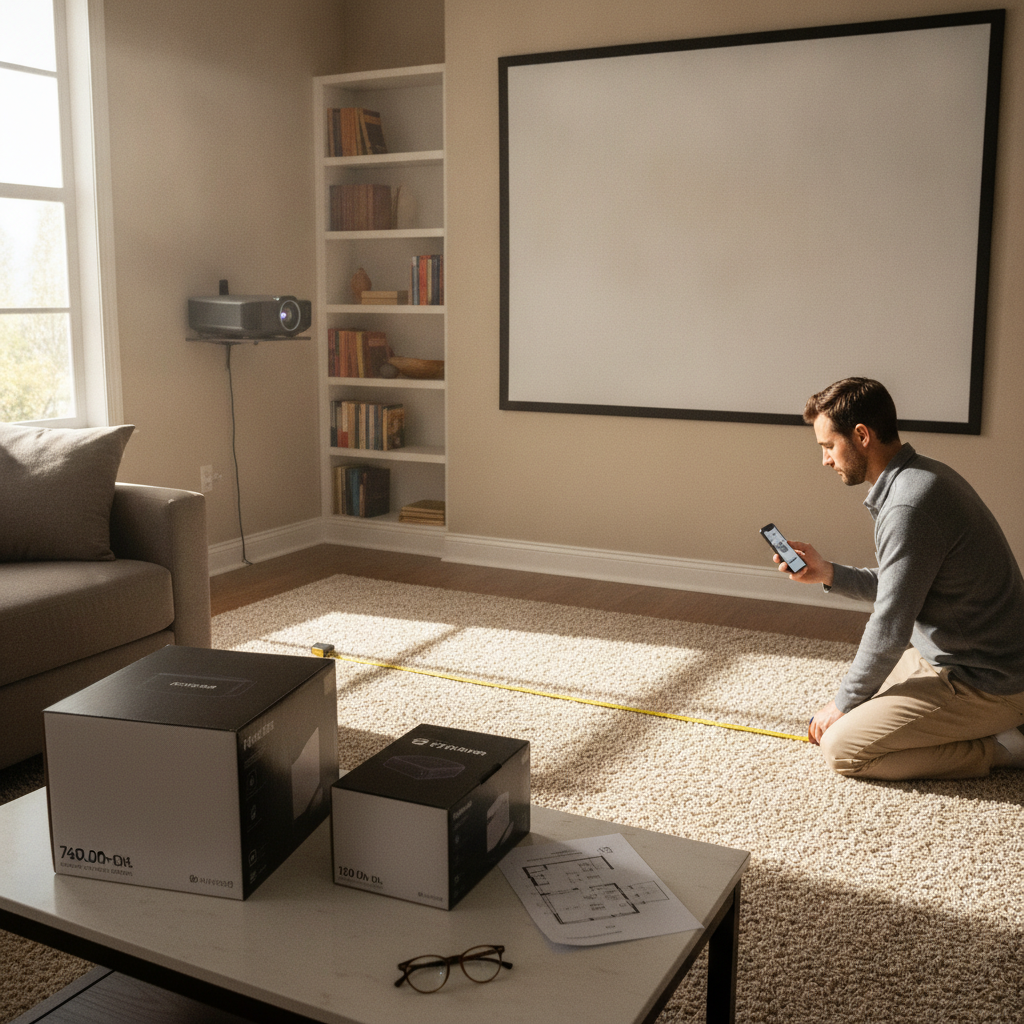
Measuring a room before selecting a projector takes less than ten minutes and eliminates most specification mismatches. Start by determining where the projector can physically be mounted or placed — ceiling mounts, shelf positions, and furniture placement all define the realistic throw distance range. Then identify the largest screen size that fits the intended wall, accounting for any trim, windows, or architectural features that limit usable projection area. Dividing the throw distance by the intended image width gives the minimum required throw ratio. A projector with a throw ratio range of 1.2:1 to 1.9:1 can accommodate that setup only if the calculated ratio falls within that window. Projectors with zoom lenses, like several models in the Sony VPL-VW series, offer more flexibility, but zoom range still has hard limits that room measurements must validate.
When High-Lumen Models Are Overkill for Smaller Spaces
Retailers frequently upsell buyers toward 3,000-plus-lumen models by framing higher brightness as universally better performance. In a small to medium room with reasonable light control, that extra output often creates problems rather than solving them. Excessive brightness in a dark room requires the projector's iris to compensate, which introduces noise and affects color accuracy. It also drives up purchase price significantly — brightness is one of the most direct cost drivers in projector pricing, so a 3,500-lumen model may cost substantially more than a 2,000-lumen alternative that is genuinely better suited to a controlled 12-by-15-foot room. Matching lumens to the actual viewing environment, rather than buying to a marketing headline, is where real value appears.
Practical Steps Before You Buy Any Projector
Before browsing product listings, take three measurements: the maximum available throw distance from mount point to screen wall, the usable screen width on that wall, and the ambient light level during your primary viewing hours. Use those numbers to calculate your required throw ratio range and establish a realistic lumen floor. You can then filter product searches on sites like Projector Central — which offers a free throw distance calculator — to surfaces only models that physically fit your room. Check whether the screen size produced at your actual throw distance matches your target, not the maximum possible image listed in the spec sheet. Compare those filtered results by price, and the projector that earns the purchase is almost always cheaper than the flagship model a showroom salesperson would have recommended.
Reading projector specifications in isolation from actual room dimensions produces purchases that look impressive on paper and underperform in practice. Throw ratio and lumen output are only meaningful relative to the space they must serve — a small, light-controlled room needs neither extreme brightness nor flexible throw range, while a large, light-permeable space demands both. Matching those two specifications to measured reality, rather than to marketing promises, is the clearest path to genuine home theater value without paying for performance the room was never going to deliver.