
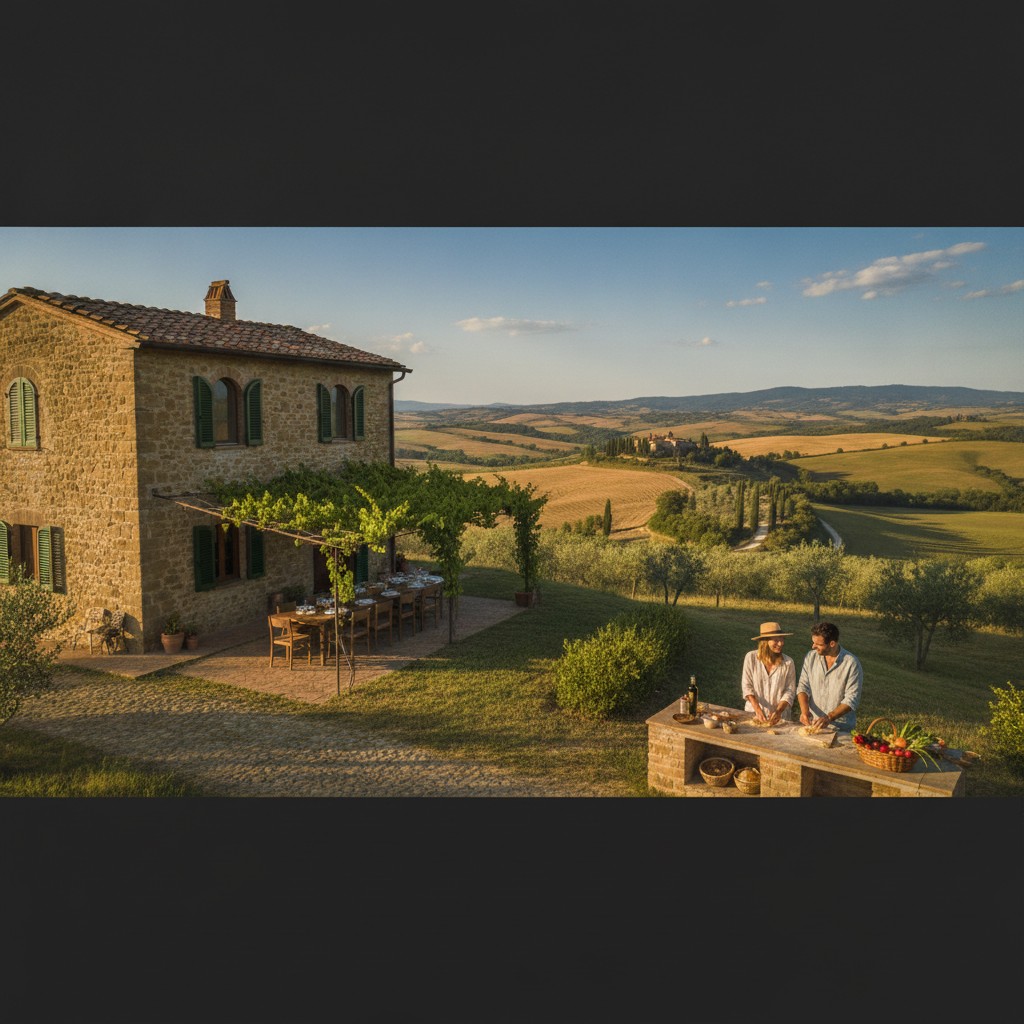
How Booking a Farmhouse Agriturismo in Tuscany's Val d'Orcia Instead of Florence Hotels Cuts Costs While Delivering a More Authentic Italian Experience
There is a version of Italy that exists beyond the hotel corridors of Florence — one that smells of wild fennel and woodsmoke, where dinner is served at a communal table and the view from the window is a rolling sequence of cypress trees disappearing into pale morning light. Most travelers never find it, not because it's difficult to reach, but because the reflex toward major cities is so deeply ingrained in how people plan European trips. The agriturismo — Italy's regulated system of farm-stay accommodation — offers a genuinely different kind of experience, and for travelers willing to trade the proximity of the Uffizi for the silence of the Val d'Orcia, the rewards are considerable, both financially and culturally.
The Agriturismo as a Living Institution
The word agriturismo (farm tourism, literally) refers to a legally defined category of accommodation in which working agricultural properties — vineyards, olive groves, wheat farms, sheep stations — open their facilities to paying guests. The Italian government established the regulatory framework for agriturismi in the 1980s as a way to support rural economies and preserve traditional farming practices, which means that a certified agriturismo must derive a meaningful portion of its income from actual agriculture, not just hospitality. This matters to the traveler because it guarantees a certain authenticity: the olive oil on the breakfast table was pressed on the property, the pecorino came from animals grazing in the field visible from the terrace, and the family running the place has roots in that land that often stretch back generations. This is fundamentally different from a boutique hotel that uses Tuscan aesthetic cues as décor.
Val d'Orcia Versus Florence: A Cost Reality
Florence remains one of Europe's most expensive short-stay destinations, particularly during the long peak season that now stretches from April through October. A mid-range hotel within reasonable walking distance of the historic center commands rates that can easily consume a significant portion of a week-long travel budget. The Val d'Orcia — the UNESCO-listed valley south of Siena that contains the towns of Pienza, Montalcino, and Bagno Vignoni — operates at a dramatically different price register. A well-regarded agriturismo in this region, offering a private apartment or suite within a restored farmhouse, often comes in at a fraction of a comparable Florence hotel rate per night, and that rate frequently includes breakfast, access to outdoor pools, and sometimes dinner prepared from the property's own harvest. When the accommodation itself becomes part of the cultural experience, the value calculation shifts entirely.
What the Countryside Offers That Cities Cannot
The Val d'Orcia is not a consolation prize for travelers priced out of Florence. The region holds its own extraordinary density of meaningful places — the Renaissance hilltop town of Pienza, designed by Pope Pius II as an ideal city and still largely intact; the Abbazia di Sant'Antimo, a Romanesque abbey near Montalcino where Augustinian monks still sing Gregorian chant at morning mass; the thermal pools of Bagno Vignoni, which have drawn bathers since Roman times. The Brunello di Montalcino wine produced in this valley is among Italy's most celebrated, and many of the estates that produce it — including well-known names like Biondi-Santi and Casanova di Neri — offer tastings that are both more intimate and more reasonably priced than comparable experiences in Chianti closer to Florence. Moving slowly through this landscape, with a farmhouse as a fixed base, produces a relationship with place that no amount of museum hopping can replicate.
Practical Booking Strategy for the Region
Booking a Val d'Orcia agriturismo requires slightly more planning than reserving a city hotel, but the process is straightforward for anyone willing to do a few hours of research. The official national registry of certified agriturismi is searchable through Agriturismo.it, which lists properties by region, amenities, and certification level. Airbnb and Booking.com carry some of the same properties, though direct booking through the property's own website typically offers better rates and allows for conversations about meal arrangements, local recommendations, and seasonal availability of farm activities. The ideal stay is a minimum of three nights — enough time to settle into the rhythm of rural life, make day trips to multiple nearby towns, and eat at least one long dinner at the farm table without feeling rushed. Renting a car is essentially non-negotiable; the Val d'Orcia's geography rewards the driver and resists the schedule-dependent traveler.
Eating as Cultural Experience
One of the most underappreciated advantages of the agriturismo model is the mezza pensione arrangement — half board, typically meaning breakfast and dinner included in the nightly rate. In practice, this means that the most culturally significant meals of the day happen on the property itself, prepared by someone with genuine knowledge of the local culinary tradition. A Tuscan farmhouse dinner might include pici all'aglione (thick hand-rolled pasta in a simple tomato and garlic sauce), a bistecca from the farm's own Chianina cattle, and a dessert made with the property's honey. This is not restaurant food designed for tourist expectations; it reflects what people in this region actually cook and eat. For travelers who care about food as a form of cultural understanding, this experience cannot be manufactured in a Florence trattoria, however skilled the kitchen.
Bringing the Experience Into Everyday Life
The traveler who books a week in the Val d'Orcia rather than five nights in a Florentine four-star comes home with something more durable than photographs of the Duomo. The slower pace of the agriturismo — meals at fixed hours, mornings without agenda, evenings lit by candles rather than phone screens — has a way of revealing how much of ordinary life gets consumed by noise that isn't strictly necessary. That recognition, carried back into the rhythms of daily existence, is arguably the real return on a well-chosen trip. The fields of the Val d'Orcia look exactly as they do in Renaissance paintings not by accident, but because something in the pace of life there resists erasure. For the traveler willing to step off the well-worn path between airport and city center, that resistance becomes a quiet, lasting gift — not unlike the scene imagined at the beginning of this consideration, where the cypress trees hold their place against the morning and the table is already set.