How Reading Blender Motor Wattage and Blade Assembly Specs Against Your Actual Use Case Prevents Overpaying for Commercial-Grade Performance a Home Kitchen Will Never Demand
Blender marketing has become remarkably skilled at making home cooks feel underpowered. Walk into any retailer carrying Vitamix, Blendtec, or Ninja, and the packaging communicates a clear hierarchy: more watts, more blades, more speed settings equal more capability. For professional kitchen environments, that hierarchy holds up. For the average household blending smoothies, soups, and the occasional salsa, it often represents several hundred dollars of performance that never gets touched.
What Motor Wattage Actually Measures in Practice
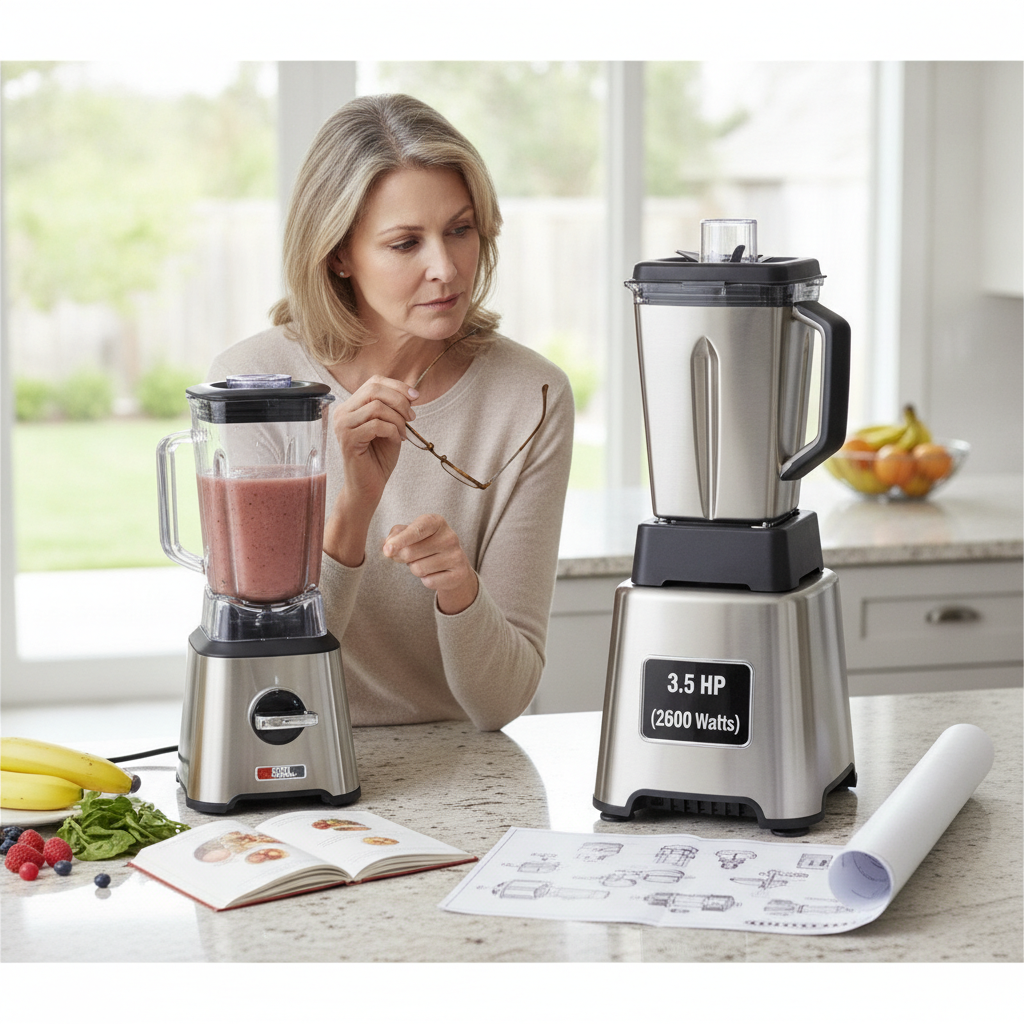
Wattage reflects how much electrical power a blender motor draws under load — it does not directly translate to blending effectiveness on its own. A 1,000-watt motor paired with poorly designed blade geometry can underperform a well-engineered 600-watt unit on everyday tasks. Commercial blenders rated at 1,400 watts or above are built to run continuously across multi-hour service periods in restaurant and juice bar environments. That sustained-use engineering adds real cost, but it solves a problem most households will never encounter. The relevant question isn't how powerful the motor is — it's whether that power matches the actual mechanical demands of the blending tasks at hand.
Blade Assembly Design and Why Geometry Matters More Than Count
Blade count is one of the more misleading specifications on blender packaging. More blades do not automatically produce smoother results. What matters is the blade's angle, sharpness, and how the assembly interacts with the vortex created inside the jar. Four-blade assemblies with the correct pitch can outperform six-blade configurations on soft ingredients like frozen fruit or cooked vegetables. Hardened stainless steel alloys hold an edge longer than standard steel, which becomes meaningful if the blender is processing fibrous greens or ice regularly. Understanding the geometry behind a blade assembly — rather than simply counting its edges — reveals far more about real-world performance.
Mapping Common Household Use Cases to Realistic Spec Requirements
Most home blenders serve a narrow range of tasks: morning smoothies, blended soups, sauces, and occasional frozen drinks. These applications require sustained torque for only seconds at a time, with significant rest between uses. For soft ingredients blended briefly, a motor in the 500–700 watt range with a quality blade assembly handles the load without strain. Ice crushing and nut butter processing push demands higher, but even there, a well-rated 900-watt unit with a proper jar design performs reliably. True commercial performance requirements — continuous blending for hours under heavy load — simply don't exist in most residential kitchens, regardless of how enthusiastically someone cooks.
Jar Design, Volume, and the Hidden Variable in Blending Efficiency
The jar's shape plays a significant role in blending efficiency that wattage ratings never capture. Narrow-bottomed containers force ingredients closer to the blade, creating more consistent contact and smoother results with less motor strain. Wide-bottomed jars common in large-volume commercial designs often require more power to generate adequate blade-to-ingredient contact — part of why high wattage accompanies large-capacity commercial units. Brands like Vitamix engineer their container geometry specifically to work with their motor output. Buying a high-watt motor without understanding the jar's role in the system can mean paying for power that compensates for design inefficiency rather than genuinely improving outcomes.
Where Specs Drift Into Diminishing Returns for Home Buyers
The spec gap between a well-chosen mid-range blender and a commercial-grade unit sold for home use is largely invisible during actual kitchen tasks. A Ninja Professional or a Vitamix E310 will produce results indistinguishable from a 1,800-watt commercial unit when blending smoothies or puréed soups. The performance difference emerges only under sustained heavy load — a condition the home kitchen rarely creates. Paying a significant premium for a commercial-grade motor's durability rating makes sense for a household blending twenty times a day. For one or two blending sessions daily, that durability engineering represents cost built entirely around a use case that doesn't exist in the home.
Reading the Spec Sheet Before You Read the Price Tag
Before browsing blenders at Best Buy or scrolling through Amazon listings, take five minutes to write down what you actually blend, how often, and in what quantities. That list becomes a filter against every specification the packaging throws at you. If your household makes smoothies three mornings a week and the occasional soup, look for a motor in the 600–900 watt range, a hardened blade assembly, and a jar shape that matches your typical batch size — usually 48 to 64 ounces. Ignore speed-setting counts above what you'll realistically use. Skip the commercial certifications that add cost for continuous-run engineering your kitchen will never stress-test. Let your use case define the spec threshold, not the other way around.
Buying a blender that genuinely matches household needs requires looking past marketing wattage claims and understanding how motor power, blade geometry, and jar design work as a system. Commercial-grade blenders solve real problems — for commercial environments. Home kitchens operate under fundamentally different demands, and choosing specifications calibrated to those demands, rather than aspirational ones, consistently delivers better value without sacrificing the blending performance a home cook actually needs.