How Reading Air Fryer Wattage, Basket Capacity, and Heating Element Configurations Against Your Actual Household Size Prevents Overpaying for Performance a Two-Person Kitchen Will Never Use
Most kitchen appliance purchases are driven by marketing language rather than technical specifications matched against actual household need. Air fryers have become one of the most aggressively marketed countertop appliances in recent years, with retailers and brands pushing high-wattage, large-capacity models as the default recommendation regardless of who's cooking. For a two-person household, this mismatch between promoted performance and practical reality can quietly inflate the purchase price by a significant margin — without delivering a single meaningful improvement in the food that lands on the table.
Why Wattage Isn't a Quality Indicator
Air fryer wattage determines how quickly the heating element reaches and maintains its target temperature, but it doesn't determine cooking quality in a vacuum. A 1,500-watt unit cooking for two people in a compact basket will consistently outperform a 1,800-watt model running the same load in an oversized chamber. When basket volume exceeds the food load, airflow circulates unevenly, hot spots form, and the cooking cycle becomes less efficient — not more. Smaller households benefit from right-sized wattage, not maximum wattage, because proportional heat delivery is what creates even browning and consistent results.
Understanding Basket Capacity and What It Actually Means
Air fryer basket capacity is measured in quarts, and the standard retail push trends toward four-quart models as a minimum and six-to-eight-quart models as a family upgrade. For a two-person household cooking one or two daily meals, a two-to-three-quart basket is functionally sufficient for the vast majority of cooking tasks — from chicken thighs to roasted vegetables to reheated leftovers. Brands like Ninja, Cosori, and Instant have all produced compact models in this range that perform exceptionally well precisely because the food fills the basket appropriately, keeping air circulation dense and consistent rather than diffuse.
How Heating Element Configuration Affects Small-Batch Cooking
Heating element placement in an air fryer — whether top-mounted radiant, wraparound, or dual-element — determines how heat distributes through the cooking chamber. Larger units with dual elements are engineered for large food volumes; running a single chicken breast through a dual-element six-quart chamber creates thermal imbalance, leading to uneven cooking and wasted energy. Compact single-element configurations are specifically optimized for smaller loads and deliver superior results when the food-to-chamber ratio is correct. For two-person households, the mechanical elegance of a well-matched smaller unit consistently outperforms the theoretical power of an oversized one.
The Price Premium Hidden Inside Unused Capacity
Retailers price air fryers along a wattage and capacity ladder, meaning every step up in size carries a corresponding price increase. That price difference is real money spent on cubic inches and watts that a two-person household will structurally never use. A compact model from Cosori or the Ninja AF101 sits in a price range meaningfully lower than their family-tier counterparts, and the performance delta for small households is negligible or negative. Beyond purchase price, there's also energy consumption to consider — a higher-wattage unit running below its optimal load cycle uses more electricity per cooking event than a right-sized model running at full capacity.
Reading Spec Sheets Before You Read the Box
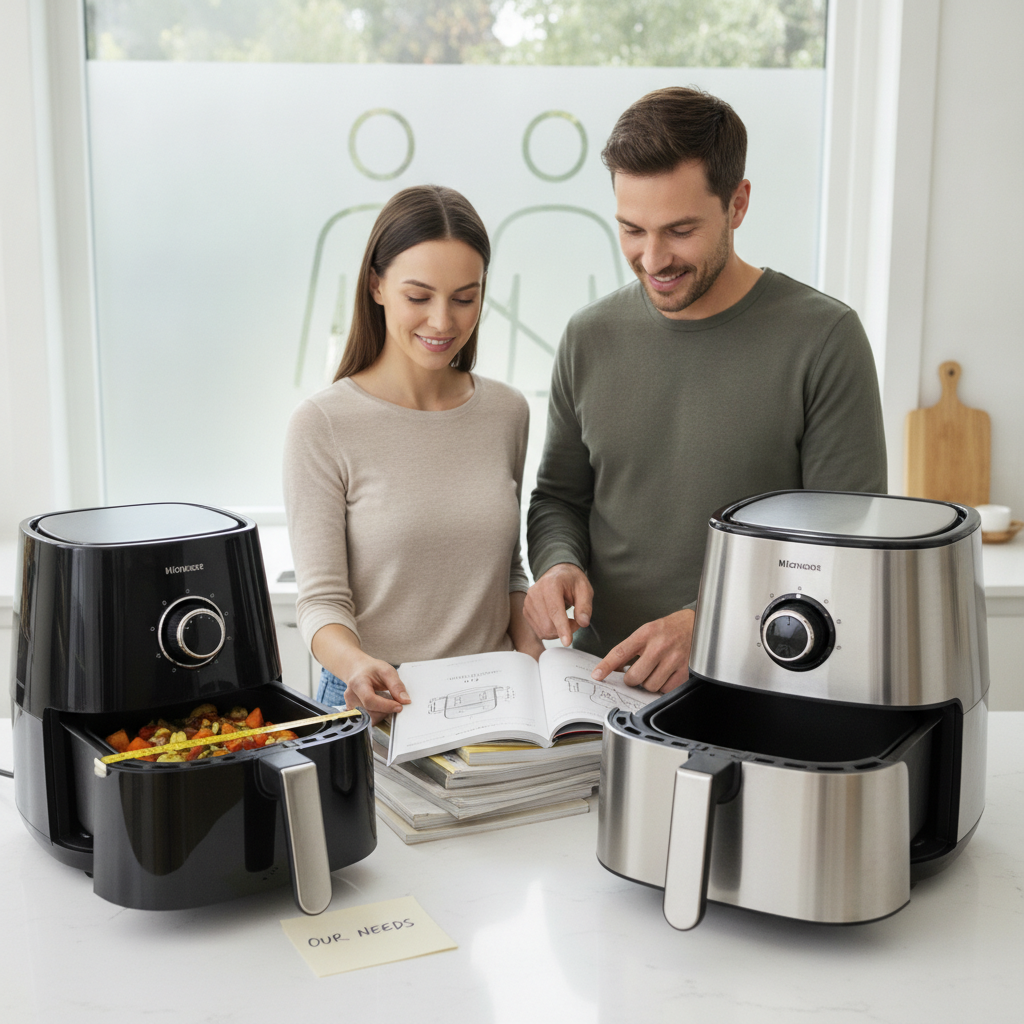
Retail packaging for air fryers emphasizes capacity, preset functions, and wattage ceiling as primary selling points because these figures photograph well and imply power. The more useful data lives on the spec sheet or manufacturer's product page: minimum recommended load, heating element type, fan speed range, and temperature variance tolerance. When you match those figures against your actual cooking habits — portion sizes, meal frequency, food types — a clear picture emerges of which model tier you actually need. Two people cooking dinner four nights a week have fundamentally different requirements than a family of five, and the spec sheet reflects that distinction far more honestly than the box copy does.
What to Actually Look for When You're Buying for Two
If your household regularly cooks for one to two people, here's the practical checklist worth running before any purchase:
- Target basket capacity between 2 and 3.5 quarts — this range covers single-meal portions without leaving excessive dead air space in the cooking chamber.
- Wattage between 1,200 and 1,500 watts is sufficient for compact models; there's no functional benefit to exceeding this for small-batch cooking.
- Look for a single top-mounted heating element with a rear-facing fan — this configuration is optimized for smaller loads and delivers the most even results at two-person portion sizes.
- Prioritize temperature range and control precision over preset buttons; accurate temperature control matters more than the number of one-touch modes.
- Check whether the basket is dishwasher-safe and whether replacement baskets are available from the manufacturer — this affects long-term cost of ownership, not just the purchase price.
- Avoid models marketed with XL or Pro designations unless you've verified that the cooking chamber size actually matches your load — these labels signal capacity upgrades, not performance upgrades.
Matching an air fryer's technical specifications to the actual scale of your household is one of the more straightforward ways to prevent paying for performance you'll never access. For two-person kitchens, the optimal buy sits in a tier that most retailers frame as entry-level — but the right size, right wattage, and right heating configuration consistently delivers better food, lower energy bills, and a purchase price that reflects genuine need rather than aspirational capacity. The best appliance isn't the most powerful one on the shelf; it's the one precisely matched to the kitchen using it.