How Designing a Deliberate Weekly Analog Skill Practice Around One Non-Digital Craft Rebuilds the Patient Focus That Instant-Result Culture Gradually Strips Away
Attention spans aren't breaking down all at once — they erode quietly, one notification at a time, one skipped step at a time, one abandoned project at a time. If you've noticed that you feel restless the moment something takes more than a few minutes to load, or that you abandon hobbies before they get interesting, you're not alone. The culture around you is engineered to deliver results fast, and that engineering has a cost: the slow, satisfying kind of focus that used to come naturally now takes real effort to access.
The good news is that focus isn't gone — it's just dormant. And one of the most effective ways to wake it back up is surprisingly low-tech: pick one non-digital craft, schedule it once a week, and show up for it consistently. That's the whole framework. What follows are eight practical ways to make that practice actually stick and actually matter.
Choose One Craft and Commit to It Fully
The temptation is to rotate between hobbies — watercolor this week, woodworking the next, maybe some sourdough after that. Resist it. The whole point of this practice is to build tolerance for the slow accumulation of skill, and that only happens when you stay with something long enough to hit the frustrating plateau. Pick one craft that genuinely interests you: hand lettering, knitting, whittling, bookbinding, pottery, leather tooling. Brands like Speedball make excellent beginner calligraphy kits; Clover offers solid knitting starter sets. The specific craft matters far less than the commitment to it.
Schedule It Like a Non-Negotiable Appointment
A vague intention to "do something creative this week" will get bumped every single time by something that feels more urgent. What actually works is treating your analog practice like a standing meeting — same day, same rough time, every week. Many people find that Saturday mornings before the household wakes up, or Tuesday evenings after dinner, become surprisingly sacred once the habit is established. Put it on your calendar. Give it a name. Protect it with the same energy you'd protect a doctor's appointment, because in a real sense, it serves a similar function.
Set Up a Dedicated Physical Space for the Practice
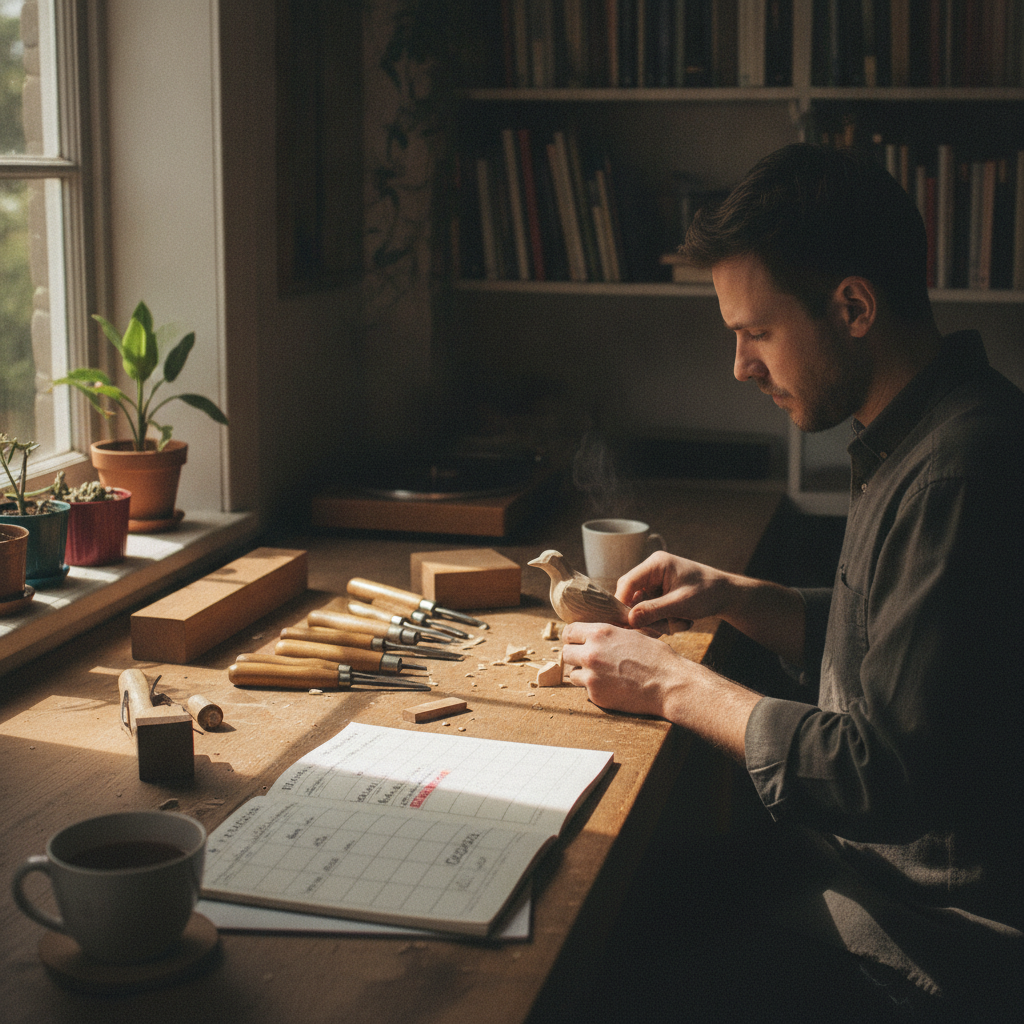
Environment shapes behavior more reliably than willpower does. When your craft supplies are buried in a closet, the friction of setup becomes a reason not to start. Instead, designate a small corner of a table, a tray on a shelf, or a dedicated basket that holds everything you need. Seeing your tools — whether that's a set of Prismacolor colored pencils or a lino-cutting block from Speedball — acts as a visual cue that keeps the habit present in your mind between sessions. The space doesn't need to be large or elaborate. It just needs to exist.
Start Each Session With a Two-Minute Settling Ritual
One reason analog crafts feel difficult at first is the gap between your mental speed and the pace of the work. You sit down with a racing mind and expect to immediately focus, and when that doesn't happen, the urge to check your phone wins. A short settling ritual bridges that gap. Before you pick up your tools, spend two minutes doing something simple and slow: make tea, sharpen a pencil, lay out your materials deliberately. This isn't wasted time — it's a gear-shift that signals your nervous system that the pace is about to change.
Embrace the Awkward Beginner Phase Without Rushing Through It
The beginner phase of any craft is uncomfortable, and that discomfort is exactly the point. When your letters are uneven or your stitches are inconsistent, the natural impulse is to search for a faster method, a better tutorial, a shortcut. The practice of staying with imperfect work — of making another bad attempt rather than abandoning the process — is what actually rebuilds patient focus. This is where the real neurological rewiring happens. YouTube tutorials from channels like The Art of Improvement can help with technique, but they can't replace the experience of sitting with difficulty and choosing to continue.
Keep a Simple Progress Log to Make Growth Visible
One of the cruelest tricks that slow skill-building plays on you is that progress becomes invisible when you're inside it. A simple log — even just a photo taken at the end of each session, or a single handwritten sentence about what you noticed — creates a record that makes growth tangible over time. After six weeks, flipping back through early attempts is often genuinely surprising. That visible arc is motivating in a way that no app can replicate, because you made it with your own hands, in real time, without an algorithm curating what you see.
Protect the Practice From Productivity Thinking
The mindset that makes analog practice most valuable is also the one that modern culture makes hardest to maintain: doing something purely for the experience of doing it, with no deliverable at the end. The moment you start thinking about selling your work on Etsy, turning your craft into content, or optimizing your technique for speed, the nature of the practice shifts. That doesn't mean those things are wrong — but they belong to a different mode. During your weekly session, the craft exists only for you. No audience, no output goal, no efficiency targets. Just the work and the quiet satisfaction of showing up for it.
Layer the Practice Into Your Broader Weekly Recovery
An analog craft session isn't just a hobby — it functions as genuine mental recovery when it's positioned correctly in your week. After several weeks of consistent practice, most people report that the hour feels qualitatively different from passive rest like watching television. The hands are occupied, the mind settles into a focused but relaxed state, and the absence of screens creates a kind of mental silence that is increasingly rare. Pairing your craft session with other recovery anchors — a slow morning, a walk without earbuds, a phone-free meal — compounds the effect and gradually rebuilds the attentional baseline that daily digital life keeps eroding.
The broader shift that's emerging in how people relate to their attention isn't a rejection of technology — it's a recognition that balance requires deliberate counterweights. As more people build analog practices into their weekly rhythms, the craft itself becomes secondary to what it produces: a quieter mind, a longer patience, and the rediscovered satisfaction of making something slowly, with your own hands, over real time.