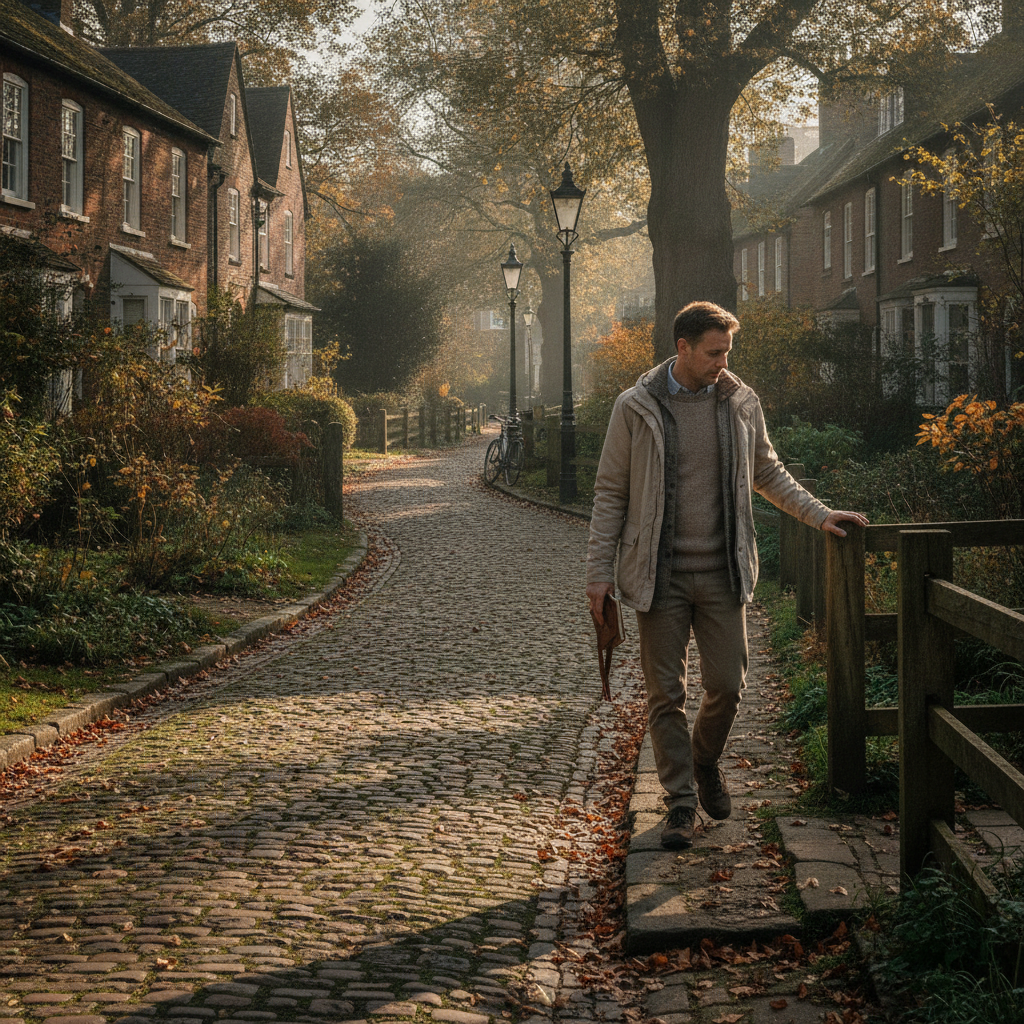
Why Structuring One Morning Per Season Around a Deliberate Neighborhood Walk Without a Destination Rebuilds the Observational Awareness That Routine Commuting Steadily Erodes
Most people move through their immediate surroundings without truly seeing them. The route from home to the train station, the drive to the office, the same sidewalk navigated six mornings out of seven — these familiar paths become a kind of perceptual autopilot, where the brain stops registering what the eyes technically observe. It's not laziness. It's efficiency. The mind learns to suppress redundant visual input so it can focus elsewhere, and after months of repetition, an entire neighborhood can become functionally invisible to the person who lives inside it.
What Does Routine Commuting Actually Do to Your Attention?
The human attention system is built for novelty and threat, not for processing scenes it has already filed away. When a commute becomes fully automatic — when every turn, every landmark, every familiar face gets categorized as background noise — the brain dedicates less and less conscious processing to the external world. Apps like Google Maps accelerate this further by offloading spatial decision-making entirely, which means commuters often arrive at destinations without retaining a single distinct memory of the journey. Over time, this creates a narrowing of observational bandwidth that extends well beyond the morning commute itself. People begin to notice less at the dinner table, less in conversation, less in their own emotional responses. The erosion isn't dramatic. It accumulates quietly, season by season, until one day a neighbor mentions a beautiful old building that apparently went up for sale, and you have no memory of ever registering it existed.
This is precisely where the seasonal walk without a destination earns its value — not as a wellness trend or a productivity hack, but as a genuine recalibration tool for the perceptual awareness that daily routine quietly dismantles.
The Role of Seasonality in Making This Work
Scheduling one of these walks per season, rather than weekly or monthly, is a deliberate choice rooted in how seasonal change transforms familiar environments. A street you walked in October looks, sounds, and smells fundamentally different in February. The light hits at a different angle. The trees are bare or blooming. The sounds of the neighborhood shift — different birds, different human activity patterns, different ambient temperatures that change how far sound travels. Building a seasonal rhythm into the practice ensures that each walk encounters a meaningfully different version of the same place, which keeps the observational engagement genuinely active rather than sliding back into the comfortable numbness of repetition. Using a simple planning app like Notion or even a paper calendar to anchor each walk to a specific seasonal date — perhaps the week after the equinox — gives the practice enough structure to actually happen without over-engineering the experience itself.
How to Structure a Walk That Has No Structure
The phrase "without a destination" is doing significant work here, and it's worth unpacking what it actually demands. Most walking done by busy adults is purposive: the morning commute, the grocery run, the school drop-off. Even leisure walks often carry an implicit endpoint — the coffee shop, the park, the loop back to the car. A walk without a destination removes the forward-pulling logic of arrival entirely, which forces a different mode of attention. When there's nowhere to be, the eyes begin to settle on things that purposive movement skips entirely: the texture of a garden wall, an unusual window treatment, a gap between buildings that opens onto something unexpected.
Timing matters more than most people anticipate. A walk taken at 7:30 on a Tuesday morning in late September offers a completely different observational landscape than the same route covered at noon on a Saturday. The quality of morning light in autumn — lower, more directional, casting longer shadows — renders familiar surfaces in ways that feel genuinely new. Early morning also brings a quieter street-level soundscape that allows finer details to register: the specific birdsong in a particular hedge, the distant sound of a bakery vent, the rhythm of a neighborhood still waking up. Apps like AllTrails can be useful for discovering adjacent streets and paths that fall just outside a habitual range, introducing mild geographic novelty without the planning overhead of an actual expedition.
Leaving the Earbuds Behind
One of the more counterintuitive requirements of this practice is the deliberate removal of audio input. Podcasts and playlists are excellent tools for making commuting time feel productive, which is exactly what makes them obstacles here. The moment audio content enters the ears, attention bifurcates — part of it tracking the spoken words or music, part of it managing physical navigation. What gets crowded out is the ambient observational layer, the quiet noticing of how a neighborhood actually sounds and feels at a specific time of year. Leaving the phone in the pocket, or at minimum disabling any notification pull, allows something that most modern adults rarely experience: unmediated sensory contact with a familiar place. It feels slightly uncomfortable at first. That discomfort is the signal that the practice is working.
What Changes After Four Seasons of This Practice
The cumulative effect of one attentive seasonal walk per year — or even one every six months — is not dramatic in a single instance, but it compounds meaningfully over time. People who maintain this practice tend to report a broader perceptual awareness in everyday life: noticing shifts in the light during a commute they've made hundreds of times, catching small changes in a colleague's office, registering the first scent of rain on dry pavement in a way that actually registers rather than passing unnoticed. The underlying mechanism is straightforward. Deliberate observation is a skill, and like any skill it atrophies without practice and sharpens with intentional use. The seasonal walk creates a low-frequency but high-quality repetition that keeps the observational muscle engaged without demanding a wholesale reorganization of daily life.
For anyone interested in tracking what they notice across seasons, a simple photo journal using an app like Day One provides a low-effort way to document visual observations without turning the walk into content creation. The goal is a private record — a few images and brief notes — that allows for genuine comparison across quarters. Seeing winter light and spring light on the same street in the same journal creates a kind of personal visual archive that deepens the sense of place over time and makes each subsequent walk feel like a continuation of an ongoing conversation with a familiar environment.
The irony of modern life is that the places people know best — their own neighborhoods, their immediate surroundings, the streets they walk every single day — are often the places they observe the least. Structuring one morning per season around a walk with no destination and no agenda is a simple act of reclamation. It doesn't require a change of scenery, a fitness goal, or a productivity framework. It requires only the willingness to move slowly through familiar ground and let what has become invisible become visible again. If a particular season is approaching, that might be the natural place to start.