
How Auditing Your Physical Environment Once Per Season Prevents the Slow Accumulation of Visual Clutter That Quietly Raises Baseline Stress Levels
The spaces people inhabit shape their mental state far more than most recognize, often without a single conscious thought about it. A countertop crowded with unopened mail, a desk buried under cables and outdated gadgets, a hallway table that has become a catch-all for miscellaneous objects — each of these conditions contributes to a subtle but measurable elevation in psychological tension. What makes this accumulation particularly insidious is its gradual nature. Clutter rarely arrives all at once. It builds incrementally, season by season, until the environment no longer supports the calm, clear thinking that daily life demands.
The Invisible Weight of Visual Overload
The human brain is wired to process everything in its field of vision, whether consciously or not. Every object in a room registers as a potential task, a deferred decision, or an unresolved loop. Neuroscientists studying attention and perception have long understood that environments dense with competing visual stimuli force the brain to perform constant low-level filtering — a process that consumes cognitive energy without producing any output. Over time, this ambient processing adds to what researchers loosely describe as baseline stress load, the underlying tension a person carries simply by moving through their day. The effect is cumulative and largely invisible until someone steps into a genuinely clear, organized space and notices the difference immediately.
Why Accumulation Happens Seasonally
Clutter does not spread randomly. It tends to follow seasonal rhythms tied to holidays, weather transitions, lifestyle shifts, and purchasing cycles. After winter, coats, boots, and holiday decorations linger in spaces originally cleared for warmer routines. Spring cleaning impulses fade before kitchen drawers are fully sorted. Summer introduces beach gear, extra hydration equipment, and outdoor furniture that somehow migrates indoors by August. Autumn brings school supplies, new fall clothing, and a fresh wave of promotional purchases. Each season deposits its own layer of objects onto existing ones, and without a deliberate review process, rooms accumulate the residue of multiple life phases simultaneously — creating an environment that feels both full and oddly unsatisfying.
What a Seasonal Audit Actually Involves
A seasonal environment audit is a structured walk-through of living and working spaces conducted four times per year, timed loosely to the solstices and equinoxes or to practical personal milestones like back-to-school transitions and post-holiday resets. The process is not about achieving a minimalist aesthetic or discarding items with sentimental value. Rather, it involves assessing each zone for objects that no longer serve the current season's functions, identifying surfaces that have become unintentional dumping grounds, and making deliberate decisions about what belongs, what should be relocated, and what should leave the space entirely. Apps like Sortly help with inventorying physical possessions, while broader decluttering frameworks popularized by methods like KonMari offer a useful decision-making filter. The audit itself typically takes two to three hours per room when done seasonally — a fraction of the effort required when years of accumulation must be addressed at once.
The Physiological Connection Between Space and Stress
The relationship between cluttered environments and elevated cortisol levels is not abstract. Studies examining home environments have consistently found that people who describe their living spaces as cluttered or unfinished report higher fatigue, lower mood, and reduced ability to transition from work stress to genuine rest. The bedroom is particularly critical — a space overloaded with visual stimulation actively impedes the brain's ability to downregulate before sleep, which compounds into chronic sleep quality issues over time. Neighborhoods like the Pearl District in Portland or Williamsburg in Brooklyn, known for intentional, design-forward living spaces, reflect a cultural understanding that physical environment directly influences quality of life. The science behind this is not aspirational; it's structural. Clear environments lower the volume of background sensory input and allow the prefrontal cortex — the brain's center for executive function — to allocate its resources more effectively.
Making the Practice Sustainable Over Time
The most common reason seasonal audits fail is that people approach them as major projects requiring large blocks of uninterrupted time. A more effective strategy is to treat the audit as a recurring appointment rather than a one-time overhaul. Scheduling a two-hour block on a Sunday in late March, late June, late September, and late December creates a predictable rhythm that prevents any single season from becoming overwhelming. Platforms like Notion or even a basic shared household calendar work well for setting these reminders and tracking what was addressed. Breaking the audit into zones — kitchen surfaces, closet transitions, home office equipment, bathroom storage — makes the process feel manageable rather than exhausting. When each zone is reviewed four times per year, the changes required at any single audit are small, targeted, and genuinely satisfying rather than demoralizing.
Putting the Seasonal Audit Into Practice
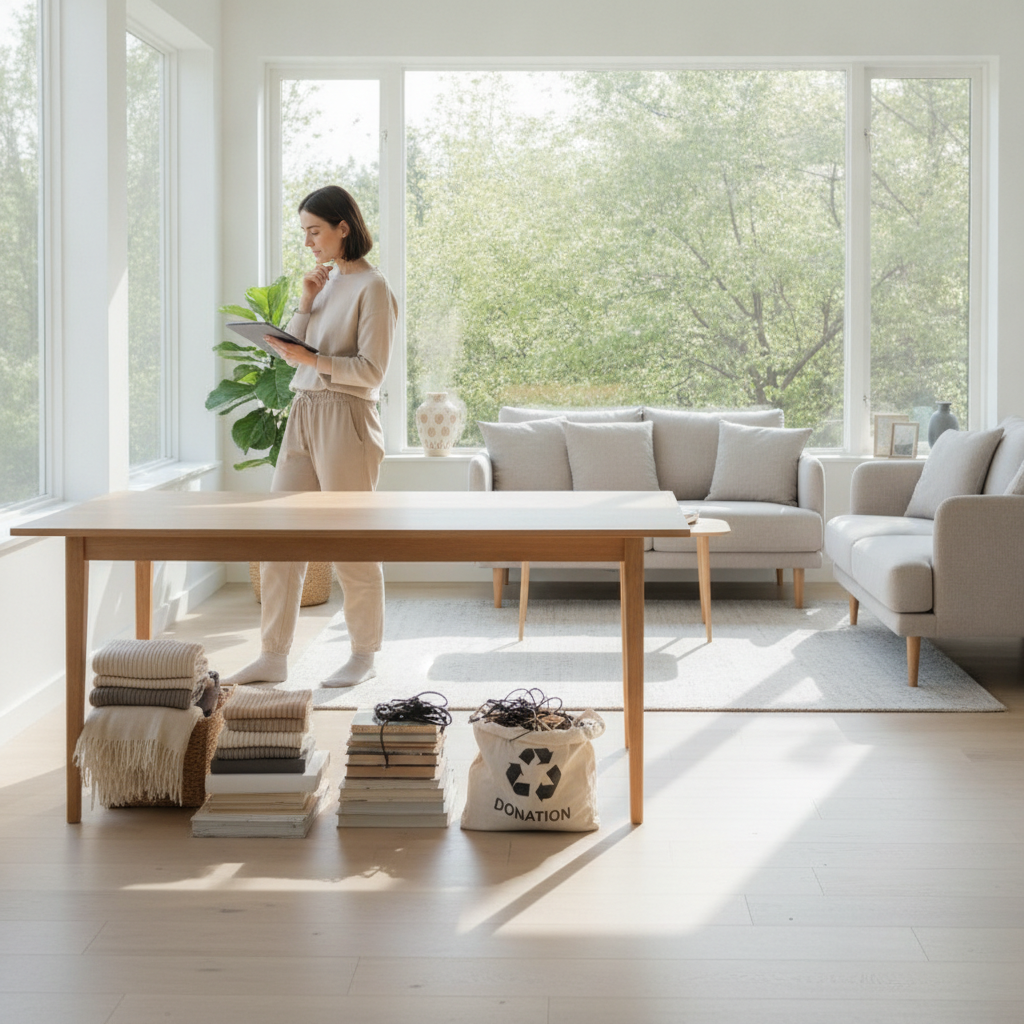
When you begin your first audit, start with a single room rather than trying to address the entire home in one session. Walk through the space with a notepad or your phone and identify three categories: objects actively used in the current season, objects belonging to a past season that should be stored or removed, and objects you genuinely cannot account for. That third category is often the most revealing — items that have been invisible for so long that you've stopped registering them as choices you made. Tackle flat surfaces first, since counters, tables, and desks are where visual clutter has the highest cognitive impact. Donate to local organizations like Goodwill or community exchange programs where items can circulate rather than go to waste. Once the audit is complete, spend five minutes in the cleared space before moving on. That deliberate pause helps anchor the psychological benefit and reinforces the habit for the next cycle.
The original observation holds at every scale: the spaces people inhabit shape their inner experience, quietly and continuously. A seasonal audit doesn't promise a perfectly curated home or a life free of complexity. What it offers is something more practical — a reliable mechanism for preventing the slow environmental drift that erodes mental clarity before anyone notices it's happening. Four intentional hours spread across a year is a modest investment for an environment that actively supports focus, rest, and the kind of grounded daily energy that makes everything else easier to manage.