
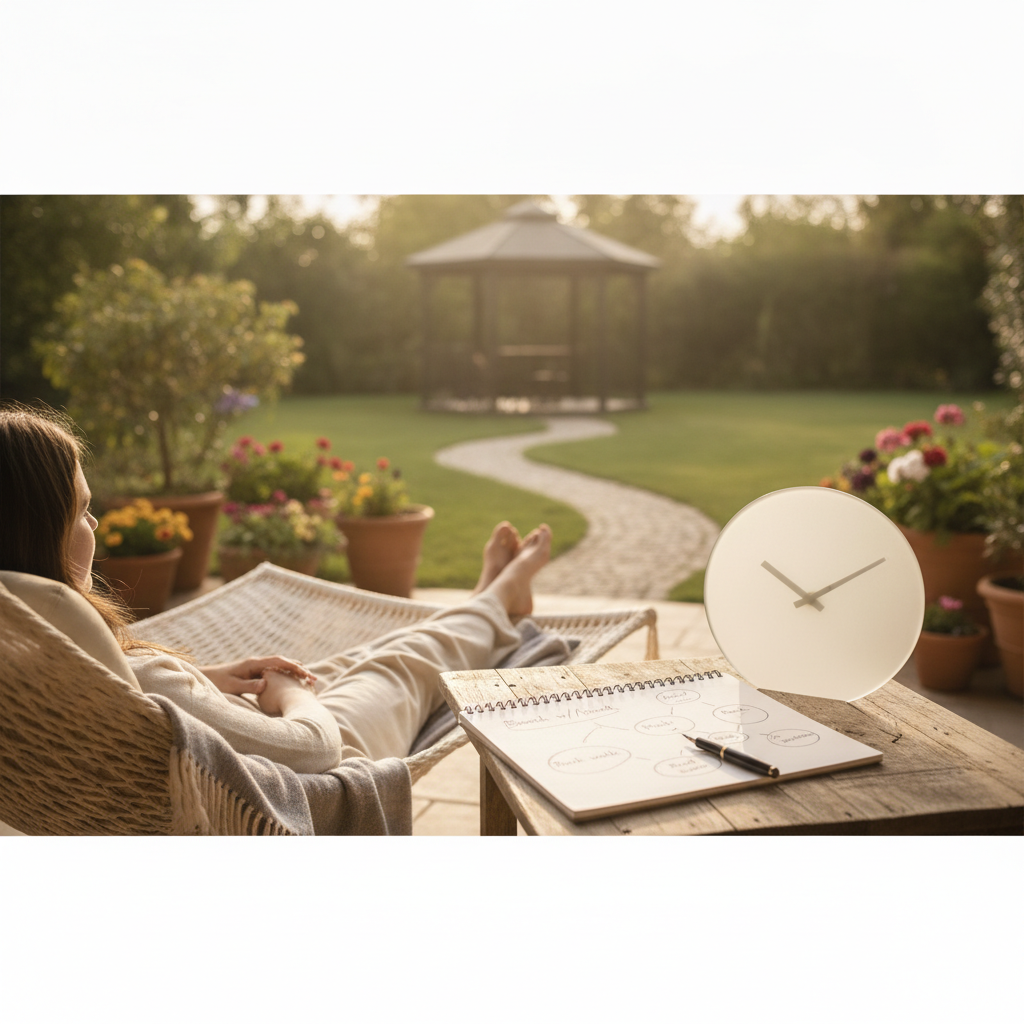
How the Reverse Planning Method Helps Chronic Overplanners Stop Micromanaging Their Own Free Time
Free time has become one of the most quietly mismanaged resources in modern life. For a particular kind of person — organized, driven, and deeply uncomfortable with open-ended hours — leisure is not experienced as rest but as a scheduling problem to be solved. The week's blank Saturday afternoon becomes a canvas for color-coded time blocks, ambitious self-improvement tasks, and the creeping anxiety that empty time is somehow wasted time. What emerges isn't relaxation; it's productivity theater with better lighting.
The Overplanner's Paradox
The chronic overplanner doesn't lack discipline — quite the opposite. These are people who use apps like Todoist or Notion with genuine devotion, who maintain multiple calendars, and who approach personal goals with the same project-management intensity they bring to work deliverables. The problem is that this intensity doesn't switch off when the workday ends. Free time gets colonized by the same planning instincts that make these people effective professionally, and in the process, something essential is lost. Rest requires a certain formlessness to function — a quality that structured planning actively destroys. The brain needs permission to wander, to make unexpected connections, to experience what psychologists sometimes call diffuse thinking, which is the kind of loose, associative mental state that often produces the most creative insights and emotional restoration.
What Reverse Planning Actually Means
Reverse planning, as a concept, has roots in project management and military strategy — the practice of starting with a defined end state and working backward to identify necessary steps. But applied to leisure, it takes on a different, more liberating character. Instead of asking "what should I do with this free time?" the reverse planner asks "how do I want to feel when this time is over?" The target is emotional and experiential rather than productive. If the answer is "restored and calm," then the planning question becomes not a schedule but a condition: what environment, pace, or activity has historically produced that feeling? This reframe shifts the brain from task-completion mode into something closer to self-knowledge mode, and for overplanners, that shift alone is quietly revolutionary.
The method has gained traction in wellness-adjacent communities in cities like Portland and Amsterdam, where the cultural tension between hustle and slow living is particularly visible. The idea resonates because it doesn't ask overplanners to abandon their planning instincts — it redirects those instincts toward a more useful question.
Working Backward From a Feeling
Practically speaking, reverse planning a block of free time begins with a deceptively simple exercise. Before structuring any activity, you sit with a single question: at the end of this afternoon, evening, or weekend, what do I want to have experienced? Not accomplished — experienced. The distinction matters enormously. An accomplishment implies a task completed and checked off; an experience implies something felt, absorbed, lived. For someone accustomed to measuring time by output, this reorientation can feel genuinely uncomfortable at first, which is itself useful information. That discomfort reveals how thoroughly the productivity mindset has infiltrated spaces that were never meant to be productive.
Once the target feeling is identified — calm, playful, connected, inspired — the reverse planner works backward to identify the minimum conditions that support it. This is where the method gently disciplines the overplanning instinct rather than eliminating it. You still plan, but you plan less. A target feeling of "playful" might require nothing more than leaving two hours genuinely open and keeping your phone in another room. A target of "connected" might mean one long, unscheduled meal with someone whose company you genuinely enjoy — no itinerary, no agenda.
The Japanese Concept of Ma and the Value of Emptiness
There's a Japanese aesthetic concept worth understanding here: ma (間), which refers to the meaningful pause, the intentional gap, the negative space that gives form to what surrounds it. In architecture, music, and conversation, ma is the empty space that allows everything else to breathe and be heard. Chronic overplanners have essentially eliminated ma from their leisure lives, packing every gap with activity until the schedule resembles a wall of sound with no rests between notes. The reverse planning method, in its quieter moments, is really an argument for reintroducing ma — not as a failure of planning, but as its most sophisticated outcome.
This isn't a call for passivity. It's a call for intentional spaciousness, which requires more self-awareness than filling time ever does.
Starting Small Without Abandoning Structure
For those whose overplanning runs deep, reverse planning works best when introduced gradually rather than applied wholesale to an entire weekend. A reasonable starting point is a single two-hour block — perhaps a Sunday afternoon — where the only planning done in advance is identifying the target feeling and removing the two or three most obvious obstacles to it. If the target is rest, that might mean silencing notifications and not opening the Todoist app. If the target is creative stimulation, it might mean leaving the house without a destination and letting curiosity guide movement through a neighborhood or bookstore.
Apps like Reflectly or even a simple paper journal can help track whether the target feeling was actually achieved, which gives the overplanner's brain the feedback loop it craves without requiring a structured schedule to get there. Over time, this practice builds what might be called leisure fluency — the ability to inhabit unstructured time without the creeping sense that something important is being neglected.
Free time was never meant to be managed. It was meant to be lived — loosely, curiously, without an exit strategy. The chronic overplanner who discovers this through reverse planning doesn't abandon their organizational gifts; they simply stop turning them on themselves during the hours that were always meant to restore what those gifts consume.