
How Designing Your Week Around One Deliberately Protected Low-Stimulation Evening Prevents the Invisible Overstimulation Debt That Accumulates Into Weekend Crashes
Most people don't burn out all at once. They burn out in thin, nearly invisible layers — a notifications-heavy Tuesday, a dinner reservation that felt social but landed draining, a Thursday evening of scrolling that masqueraded as rest. By Friday night, something feels off, and by Sunday, the whole weekend somehow vanished without leaving you restored. That pattern isn't a motivation problem or a discipline problem. It's a stimulation management problem, and it's one most productivity frameworks completely ignore.
The fix isn't a complicated overhaul of your entire week. It's one protected evening — deliberately chosen, consistently defended, and designed to keep your nervous system from quietly going into the red.
Understand What Overstimulation Debt Actually Is
Your nervous system runs like a budget. Every high-input experience — a meeting-heavy workday, a crowded commute through Penn Station, a lively dinner with friends, even a compelling Netflix episode — costs something. The debt accumulates when spending consistently exceeds recovery. Unlike physical fatigue, which shows up clearly in sore muscles or heavy eyes, overstimulation debt is subtle. It presents as mild irritability, difficulty concentrating, a low-grade feeling that you can't fully explain. By the time it surfaces as a weekend crash, it has usually been compiling since midweek. Naming it helps you treat it strategically rather than reactively.
Choose Your Evening Before the Week Chooses It for You
The single biggest mistake people make with this practice is waiting to see which evening happens to stay clear. Busy weeks don't produce accidental quiet evenings — they fill every available slot. Wednesday works well for most people because it creates a true midpoint buffer between the week's two halves. Tuesday is a solid alternative if Wednesdays tend to carry standing commitments. The specific night matters less than the decision to claim it before anything else gets scheduled. Put it in your calendar like a meeting you can't reschedule, because for your nervous system, it essentially is one. Apps like Reclaim or Sunsama make protecting recurring blocks significantly easier if digital calendars are your primary organizing tool.
Define What Low-Stimulation Actually Means for You
Low-stimulation looks different depending on your baseline. For someone whose workday is primarily solo deep work, a quiet evening might still include background music and light cooking. For someone who fields client calls from nine to six, it might mean complete auditory quiet and minimal decision-making after seven. The common thread is reduced cognitive and sensory input — fewer decisions, lower noise levels, no screens demanding rapid emotional responses, and no social performance required. What doesn't count: anything that keeps your brain scanning for new information, managing social cues, or responding to incoming demands. Podcasts, group texts, and even compelling books can break the threshold depending on your current baseline.
Design the Evening Around Sensory Downshift
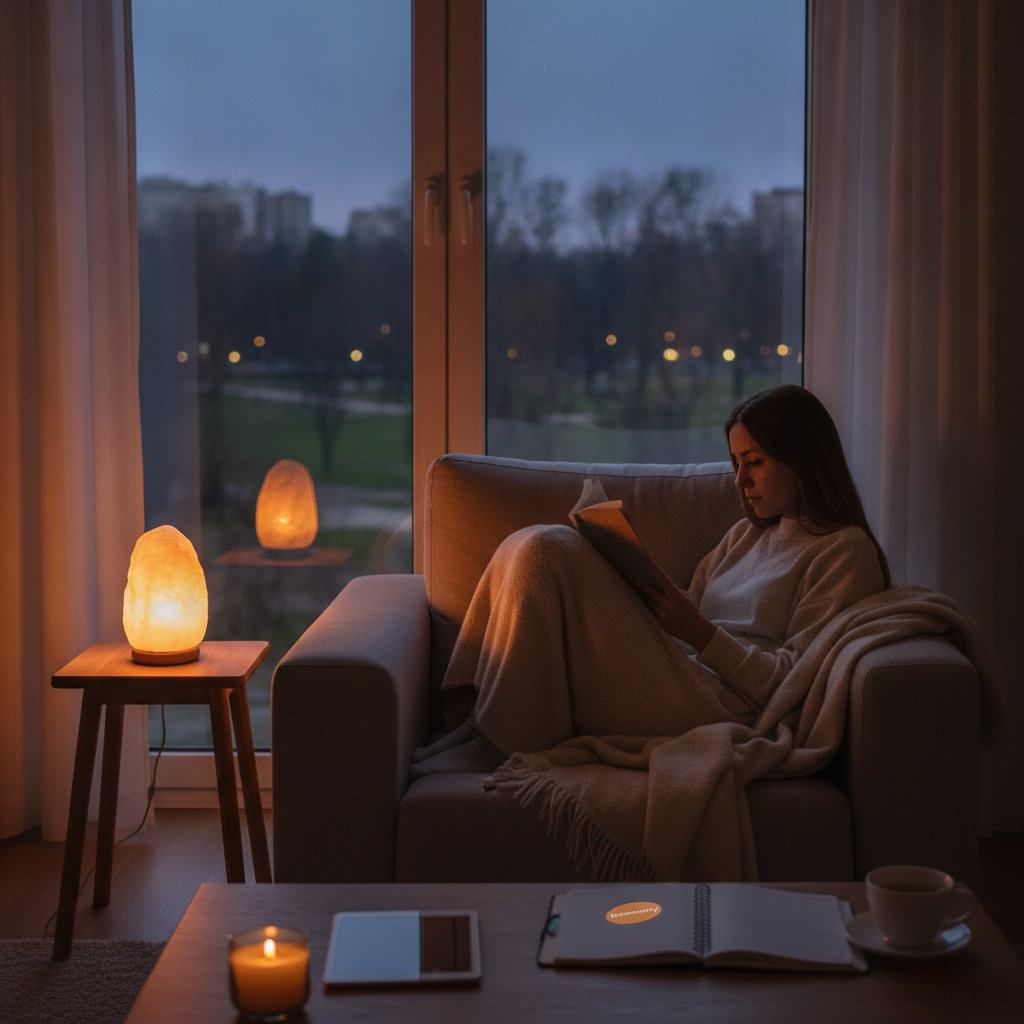
Structure the evening in layers that progressively reduce stimulation rather than cutting input abruptly. Start with something gentle and physical — a walk around your neighborhood, light stretching, or cooking a simple meal without a recipe. Apps like Insight Timer offer short body-scan sessions that transition well into this kind of evening. Move into something that requires minimal cognitive load: a reread of a book you already love, drawing, or organizing a physical space. Close with low-light conditions, ideally with a lamp on a warm color temperature rather than overhead lighting, and either silence or ambient sound. The sequence matters because abrupt transitions from high-stimulation states into forced stillness rarely work — the nervous system needs a ramp, not a wall.
Protect It From the Guilt That Will Show Up
Somewhere around week two or three, a social invitation will land on your protected evening and feel genuinely difficult to decline. A friend visiting from out of town, a team dinner that isn't technically mandatory, a family event that requires some negotiation. This is where most people quietly abandon the practice. The reframe that actually helps is economic: you're not declining an event; you're honoring a prior commitment to your capacity for the rest of the week. Missing the protected evening in week three and crashing by Saturday morning is data, not failure. Use it to reinforce why the boundary exists. Telling the people closest to you about the practice also reduces the friction of saying no repeatedly.
Watch for the Creep of Productive Quiet
One of the most common ways this practice gets quietly undermined is by filling the protected evening with low-urgency but still cognitively active tasks — clearing email, reorganizing a home office, catching up on reading that feels useful rather than restful. This version of the evening looks quiet but isn't low-stimulation in any meaningful sense. The brain is still scanning, still evaluating, still producing outputs. True nervous system recovery requires genuinely passive or creative-without-pressure engagement. The rule of thumb: if you're producing outputs or processing new information, it's work in a different costume. The evening needs to function more like a system in idle than a system running maintenance.
Notice the Weekly Rhythm It Creates
After four to six consistent weeks, most people notice a structural shift in how the whole week feels — not just the protected evening. The midweek pause creates a natural checkpoint that makes the second half of the week feel navigable rather than merely something to survive. Without it, Monday through Friday tends to blur into a single continuous drain that only fully surfaces on Saturday morning. With it, there's a seam in the middle — a point where the system resets slightly before continuing. That seam changes how you show up Thursday and Friday. It also changes what Saturday actually delivers, because you arrive at the weekend without the hidden debt that usually determines whether you can enjoy it at all.
Adjust the Format Seasonally Without Abandoning the Structure
What the protected evening looks like in January — long indoor evenings with minimal light, perhaps more solitary — will naturally shift in June when longer days invite a slow walk through a neighborhood park or sitting outside in the evening quiet. The practice doesn't need to look identical year-round. What needs to stay consistent is the function: one evening per week where your nervous system doesn't have to perform, respond, or produce. As life changes — a new job, a new city, shifting family dynamics — the format adapts while the commitment stays. That flexibility is what makes the practice sustainable across seasons rather than something that only works under ideal conditions.
The relationship between daily stimulation and weekend recovery is one that most people understand intuitively but rarely manage deliberately. As awareness of nervous system health continues to grow in everyday conversations about well-being, designing rest into the structure of a week — rather than hoping it appears spontaneously — is becoming less of a wellness niche and more of a practical baseline. One protected evening isn't a luxury. It's the structural anchor that keeps everything else from quietly unraveling by Friday.